Evidence curated 29 September 2026. This post brings together the corrected H2/O2 benchmarks and the n-heptane ignition-plus-front experiment. The numerical cutoff includes the completed Balance test at code step \(4\times10^{-4}\). The \(8\times10^{-4}\) comparison has reserved slots below; its numerical results are not included in this edition. No new CFD was launched during curation.
Conclusions and evidence coverage
- broadA remains the established flame-preserving recipe. BA-CE6 reproduces its ESDIRK2 flame-speed behavior while allowing chemically difficult, weakly diffusive ignition states to select Strang. However, the archived flame matrices are fixed-inner-work calculations, not converged implicit solutions.
- Detonation does not have a universal preferred endpoint. On the same fine grid, ESDIRK2 at \(8\times10^{-7}\) favors Strang, while U2R2 at that step favors coupled. No BA-CE6 detonation a-posteriori matrix exists in the archive; similarity of its frozen selector to broadA is not a substitute for one.
- The two-scale case exposes different regional errors. At matched \(4\times10^{-4}\), coupled better preserves the interface’s worst temperature error than Strang, but has much larger ignition-kernel error. Balance retains localized interface mixing and improves kernel errors substantially relative to coupled. It does not win every metric, and its small mean-error advantage over Strang is below the available reference-refinement sensitivity.
- BA-CE6 is too eager to escape in this particular prepared case. It selects Strang everywhere in all 55 evaluated snapshot/timestep combinations. Balance is a rate-balance alternative, not a validated universal replacement.
| Evidence | broadA | BA-CE6 | Balance |
|---|---|---|---|
| Corrected H2/O2 flame, 3 ODE × 3 steps, with endpoint controls | Complete terminal accounting | Same campaign: 31 completed, 5 failed across all 36 rows | Unrun |
| Fine H2/O2 detonation, 3 ODE × 4 steps, plus coarse ESDIRK2 | Complete: 52 rows including endpoints/default | Unrun; a-priori only | Unrun |
| Earlier hot n-heptane, ESDIRK2 × 5 steps × 4 treatments | Complete | Complete | Unrun |
| Prepared ignition + front, same-checkpoint short window | Completed at \(2\times10^{-4}\) and \(4\times10^{-4}\) | A-priori only; not a separate CFD row | Completed at \(4\times10^{-4}\) |
| Prepared ignition + front, \(8\times10^{-4}\) | Pending integration | Not scheduled | Pending integration |
“Complete accounting” includes failures; it does not mean every row yields a valid accuracy result. The detailed two-scale report contains all comparison plots, tables, startup records and frozen-state figures. The linked study records require access to the research repository; the figures needed to read this post are included on this page.
Common mixed-integration contract
Let \(U\) be the cell-mean conservative state, \(F(U)\) the spatial flow residual (convection and diffusion, with nonchemical sources if present), and \(S(U)\) the local chemical source. For a field \(\chi_i\in[0,1]\) frozen at the beginning of each physical step, partition the evolution as
$$ \frac{\mathrm dU}{\mathrm dt}=F(U)+S(U),\qquad G_\chi(U)=F(U)+(1-\chi)S(U),\qquad Q_\chi(U)=\chi S(U). $$Advance \(Q_\chi\) for half a step, \(G_\chi\) for a full step, and \(Q_\chi\) for half a step. The cell-local chemistry advance is constant-volume; the flow advance uses the selected ODE method. Thus \(\chi=0\) is fully coupled and \(\chi=1\) is full Strang. Values strictly between them split only part of the chemistry. This is not a convex combination of two completed solutions. The separate debugging source multiplier multiplies chemistry independently; it is unity in these studies. Nonchemical sources are not multiplied by \(\chi\).
All three retained recipes use the same snapping operator and zero spatial passes:
$$ \mathcal P(z)= \begin{cases} 0,&z\le0.01,\\ z,&0.01\lt z\lt0.95,\\ 1,&z\ge0.95. \end{cases} $$Exact zero skips that cell’s split chemistry advance; exact one removes its chemistry work from the implicit flow RHS. The upper threshold here is the retained recipe’s 0.05 distance from one, not the general solver default. Post-step diagnostic output contains the last pre-step frozen selector, not necessarily a selector reevaluated on the plotted final state.
The common threshold-and-power function is
$$ H(z;z_0,p)=\frac{(z/z_0)^p}{1+(z/z_0)^p},\qquad z\ge0,\quad z_0>0,\quad p>0. $$\(z_0\) is the half-activation value and \(p\) controls transition sharpness. All arguments and thresholds below are dimensionless. The physical step is \(\Delta t=\Delta t_{\rm code}L_0/U_0\); for the two-scale case, \(L_0=1\,\mathrm m\), \(U_0=379\,\mathrm{m\,s^{-1}}\).
Constituent fields used by broadA and BA-CE6
For species \(k\), let \(Y_k\) be mass fraction, \(W_k\) molecular weight, \(\dot\omega_k\) net molar production per volume per time, and \(\dot m_k=W_k\dot\omega_k\) net mass production per volume per time. \(\rho\) is mass density; \(T\) is absolute temperature; \(c_v\) is mixture mass-specific constant-volume heat capacity; \(h_k\) is species mass-specific enthalpy including formation enthalpy. Define
$$ \dot q_h=-\sum_k h_k\dot m_k,\qquad T_{\rm scale}=\max(T,T_{\rm floor}),\qquad A=\left[\sum_k\left(\frac{\dot m_k}{\rho}\right)^2+ \left(\frac{\dot q_h}{\rho c_vT_{\rm scale}}\right)^2\right]^{1/2}. $$\(\dot q_h\) is an enthalpy-based volumetric heat-release proxy in \(\mathrm{W\,m^{-3}}\), not an exact constant-volume temperature derivative. \(T_{\rm scale}\) is a temperature in kelvin; the ratio in \(A\) has units \(\mathrm{s^{-1}}\). \(T_{\rm floor}\) is the mechanism’s supported lower temperature bound. There is no logarithm of a dimensional temperature.
For face-neighbor cells \(i,j\), let \(\ell_{ij}\) be physical center distance, \(\ell_i\) the physical maximum cell-length scale, and \(Y_*=10^{-3}\). The solver-form gradient estimate is
$$ G_i=\max_{j\in\mathcal N(i)}\left[ \left(\frac{T_j-T_i}{\ell_{ij}\max(T_i,T_j,T_{\rm floor})}\right)^2+ \sum_{k:\,\max(Y_{k,i},Y_{k,j})\ge Y_*} \left(\frac{Y_{k,j}-Y_{k,i}}{\ell_{ij}\max(Y_{k,i},Y_{k,j},Y_*)}\right)^2 \right]^{1/2}. $$$$ L_{{\rm grad},i}=\max(G_i^{-1},\ell_i),\qquad B_i=\frac{D_{\max,i}}{L_{{\rm grad},i}^{2}},\qquad a_i=\Delta t A_i,\quad b_i=\Delta t B_i. $$Use \(B_i=0\) when \(G_i=0\). \(D_{\max}\) is the largest mixture-averaged species diffusivity in \(\mathrm{m^2\,s^{-1}}\). \(B\) is an inverse-time diffusion-scale estimate, not an evaluated diffusive RHS. Physical-boundary faces without a neighbor do not add a jump. The temperature term approximates the gradient of \(\ln(T/T_{\rm ref})\) for any fixed positive reference temperature; the finite difference is not exactly a logarithmic difference. The cell-length bound limits activation by gradients below the represented spatial scale.
The pressure sensor and shock suppression are
$$ h_i=\max_{j\in\mathcal N(i)} \frac{|p_j-p_i|}{\max(|p_i|,|p_j|,p_\epsilon)},\qquad g_{h,i}=\frac{1}{1+(h_i/0.08)^4}. $$Here \(p\) is pressure and \(p_\epsilon\) is only a positive numerical safeguard, negligible in these positive-pressure cases. The symbol \(h_i\) denotes a pressure jump, distinct from species enthalpy \(h_k\). Strong jumps reduce coupling; this is an empirical shock preference, not a theorem that Strang is always more accurate in detonations.
broadA: broad activity activation
$$ C_A=H(a;10,1/2)H(b;2,1/2)g_h,\qquad f_A=H(C_A;0.005,3),\qquad \chi_A=\mathcal P(1-f_A). $$\(f_A\) is the raw coupled fraction. The square-root Hill factors activate gradually, and the low outer midpoint broadens the coupled band relative to the earlier default. No expansion/filter passes are used. \(A\) and \(B\) must both be nonzero. At fixed positive rates, \(\Delta t\to0\) gives Strang; \(\Delta t\to\infty\) gives raw coupled fraction \(H(g_h;0.005,3)\). Hence a smooth, weakly diffusive but very stiff ignition region can eventually become strongly coupled even when that is not advantageous.
BA-CE6: broadA with chemistry escape
Define the concentration-Jacobian proxy
$$ \Lambda=\max_k\left|\frac{\partial\dot\omega_k}{\partial C_k}\right|, \qquad s=\Delta t\Lambda,\qquad r=\frac{B}{\Lambda}, $$where \(C_k\) is species molar concentration. The diagonal derivatives use
Cantera’s net_production_rates_ddCi: temperature, pressure and all other
species concentrations are held fixed under that API’s derivative convention.
Cantera kinetics reference.
This is
not the spectral radius of the full constant-energy reactor Jacobian, nor a
measured nonlinear convergence rate. \(\Lambda\) has units \(\mathrm{s^{-1}}\).
For \(\Lambda>0\), set
Set \(E=0\) when \(\Lambda=0\). The gate releases chemistry toward Strang when the timestep is long relative to the fast chemical scale and diffusion is weak relative to that scale. It can only remove broadA coupling. “6” is the power on the \(B/\Lambda\) gate, not an ODE order. At positive fixed rates,
$$ f_{{\rm CE6},\infty}=H(g_h;0.005,3)H(B/\Lambda;10^{-6},6). $$This preserves the tested H2/O2 flame band but can erase a real interface if a very fast chemical mode drives \(B/\Lambda\) below the threshold. The numerical value \(10^{-6}\) is calibrated, not a universal physical boundary. This recipe is the refined mode-2 BA-CE6, not the earlier unsuccessful ratio-only v2.
Balance: compare actual chemical and diffusive rate coordinates
Use all species and temperature in the same coordinates:
$$ \mathcal A=\left[\sum_k\dot Y_{S,k}^{2}+(\dot T_S/T)^2\right]^{1/2}, \qquad \mathcal D=\left[\sum_k\dot Y_{D,k}^{2}+(\dot T_D/T)^2\right]^{1/2}. $$Both norms have units \(\mathrm{s^{-1}}\). They contain no division by trace species fractions. With species mass-specific internal energy \(e_k(T)\), including formation energy,
$$ \dot Y_{S,k}=\dot m_k/\rho,\qquad \rho c_v\dot T_S=-\sum_k e_k\dot m_k. $$Unlike broadA’s \(\dot q_h\) proxy, this chemical temperature rate is consistent with fixed volume and total energy. For molecular diffusion, form
$$ \mathbf j_k^{0}=-\rho D_k\nabla Y_k,\qquad \mathbf j_k=\mathbf j_k^{0}-Y_k\sum_l\mathbf j_l^{0},\qquad \mathbf q=-\kappa\nabla T+\sum_k h_k\mathbf j_k, $$$$ S_{D,k}=-\nabla\cdot\mathbf j_k,\qquad \dot Y_{D,k}=S_{D,k}/\rho,\qquad \rho c_v\dot T_D=-\nabla\cdot\mathbf q-\sum_k e_kS_{D,k}. $$\(\kappa\) is thermal conductivity; \(\mathbf j_k\) is a mass flux with zero summed species flux; \(\mathbf q\) includes conduction and diffusing species enthalpy. The last subtraction removes composition-induced internal-energy change before converting the energy rate to a temperature rate. In the diagnostic, centered two-point cell-mean gradients and averaged face coefficients estimate these divergences. Physical-boundary diffusive flux is zero. This estimator does not replace the solver’s reconstructed spatial residual and does not include convection, compression or viscous heating.
$$ \alpha=\Delta t\mathcal A,\qquad d=\Delta t\mathcal D,\qquad Z=\frac{\alpha d}{(1+\alpha)^2},\qquad \chi_{\rm Balance}=\mathcal P\left(\frac{1}{1+(g_hZ/\theta)^p}\right), \qquad \theta=0.001,\quad p=2. $$\(\alpha\) is deliberately distinguished from broadA’s \(a\): its temperature component uses internal energy rather than enthalpy. The midpoint and power were selected from an a-priori screen before this candidate’s CFD result: \(\theta\in\{0.0005,0.001,0.002,0.005,0.01,0.02\}\), \(p\in\{2,3\}\). There is no Jacobian, chemistry-escape ratio or additional activity gate. The shared shock gate and endpoint thresholds remain parameters.
For fixed nonzero \(\mathcal A\),
$$ Z\sim\Delta t^2\mathcal A\mathcal D\quad(\Delta t\to0),\qquad Z\longrightarrow\mathcal D/\mathcal A\quad(\Delta t\to\infty). $$Zero chemistry or diffusion selects Strang. Large-step coupling therefore requires an appreciable current diffusive rate relative to chemical rate, not merely a large gradient multiplied by an arbitrarily large timestep. Net-rate cancellation, stiff near-equilibrium chemistry, omitted convection, mesh dependence and physical boundary modeling remain blind spots. The implementation has only been validated on this orthogonal, closed strip.
H2/O2 flame: complete latest four-treatment matrix
This is the BA-CE6 campaign, with
its own rerun broadA and endpoint controls, rather than selectively combining
rows from different campaigns. It uses the corrected multispecies temperature
gradient, a Cantera stationary initial profile, fresh BCIn and burned BCFar,
\(25\,\mu\mathrm m\) spacing, P1 FV, and final code time 0.5. The reference is
\(S_{L,\rm ref}=2.2539659772\,\mathrm{m\,s^{-1}}\). Burning velocity is recovered
from fresh-gas velocity minus fitted laboratory-frame front speed:
Fits use code times 0.2–0.5. ODE codes are 204 (ESDIRK2), 412 (U2R1) and 411 (U2R2). All 36 requested rows have terminal accounting: 31 completed and five Strang failures. All 11,212 physical steps of the completed rows hit the 100-iteration cap; 15,255 observed implicit-stage groups are capped. These are fixed-work observations. An asterisk below marks \(R^2<0.9\), where the fitted speed is only an interval average, not a reliable steady speed.
| ODE | Code dt | Coupled | Strang | broadA | BA-CE6 |
|---|---|---|---|---|---|
| ESDIRK2 | 0.00075 | -1.223% | +1.259% | -1.186% | -1.186% |
| ESDIRK2 | 0.002 | -1.001% | +13.931% | -1.112%* | -1.112%* |
| ESDIRK2 | 0.004 | -1.235% | failed | -1.119% | -1.119% |
| U2R1 | 0.00075 | -1.050% | -0.979% | -1.218% | -1.218% |
| U2R1 | 0.002 | +2.680%* | +3.466% | +2.107% | +2.107% |
| U2R1 | 0.004 | +38.652%* | failed | +16.707%* | +7.681%* |
| U2R2 | 0.00075 | -1.025% | failed | -1.075% | -1.075% |
| U2R2 | 0.002 | -1.268% | failed | -1.391%* | -1.572%* |
| U2R2 | 0.004 | -1.911% | failed | -1.831%* | -1.885%* |
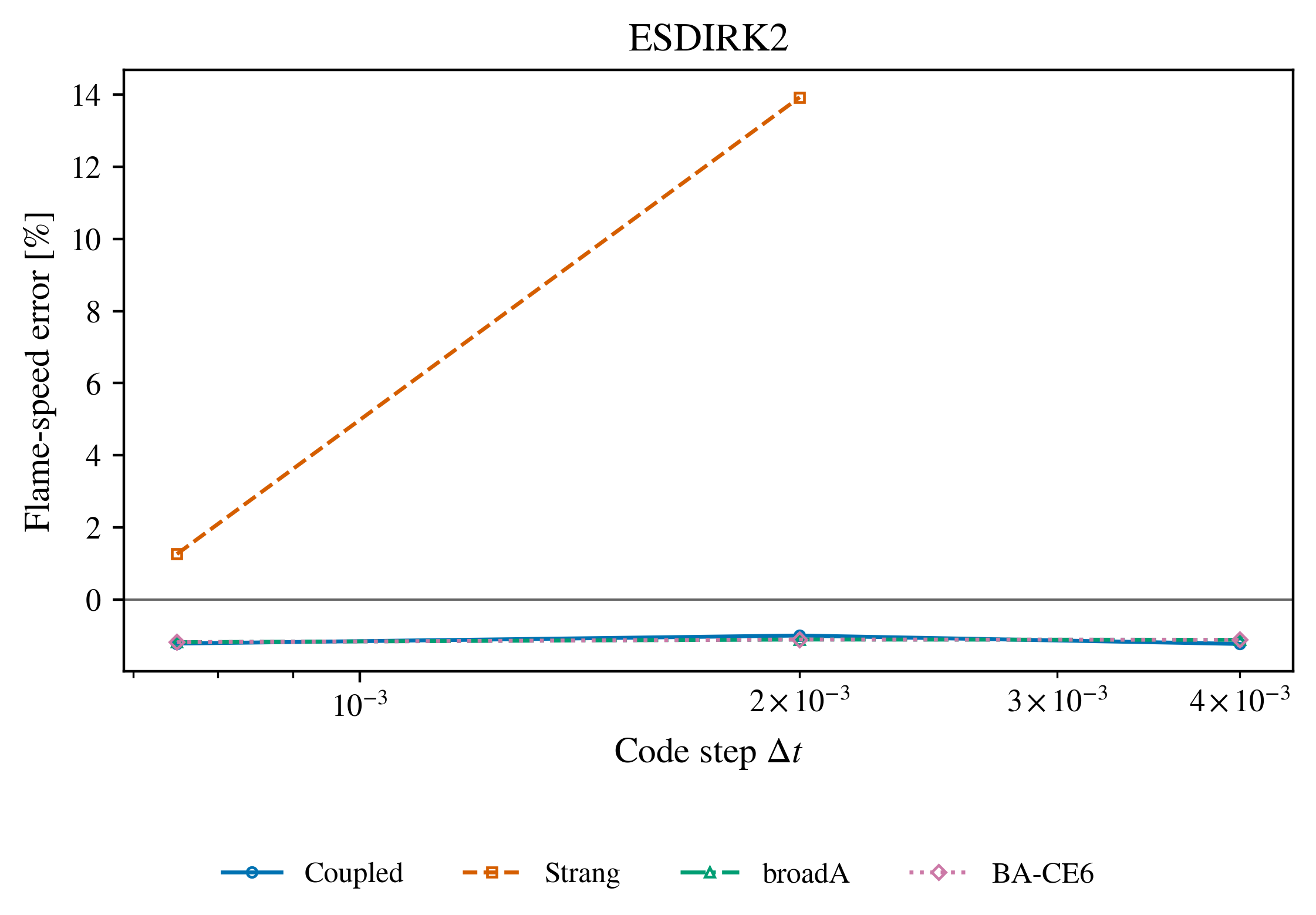
ESDIRK2 flame errors. broadA and BA-CE6 retain roughly −1.1% fitted error; Strang reaches +13.9% at the middle step and fails at the largest. All completed curves are inner-capped, including those close to the reference speed.
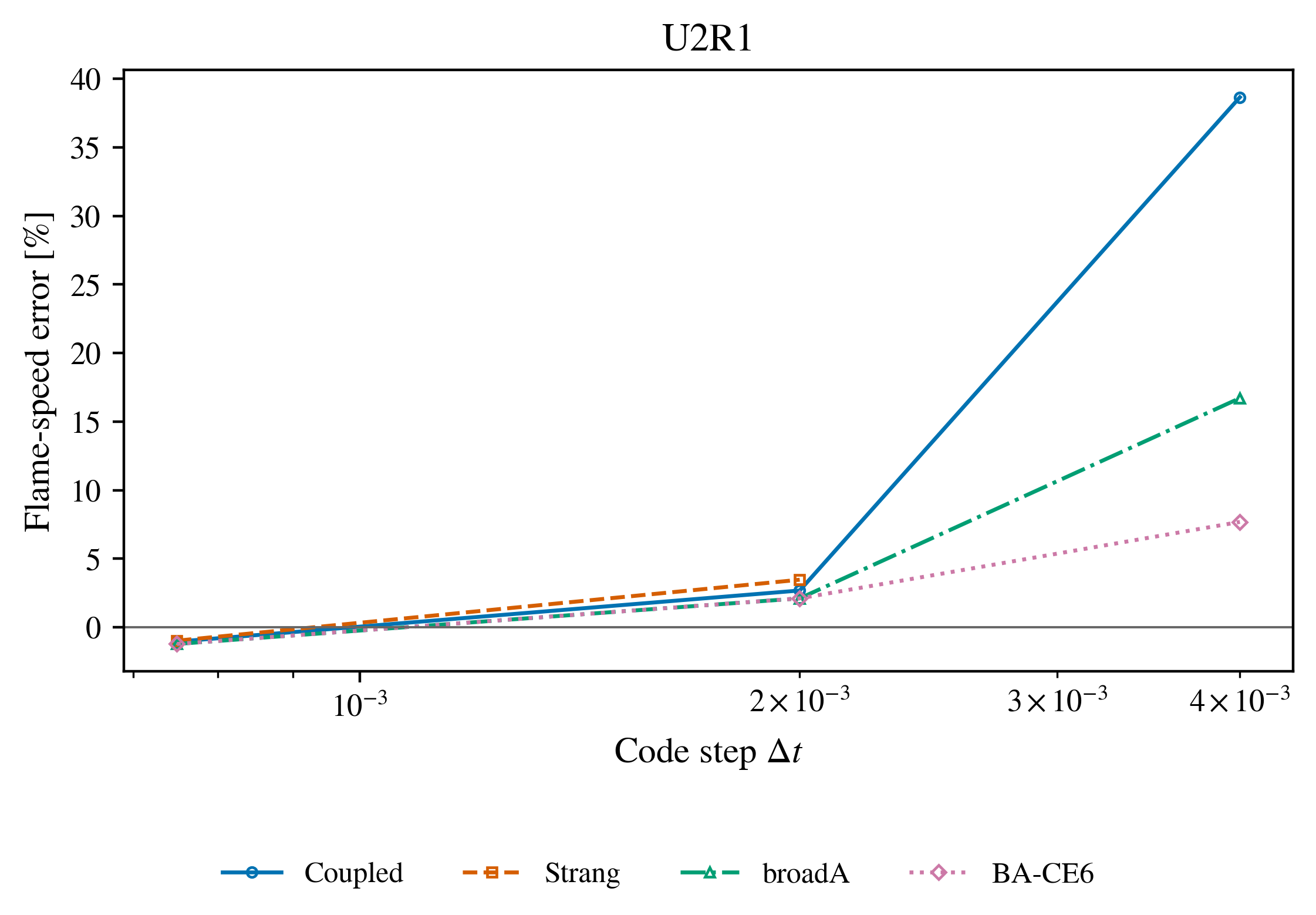
U2R1 flame errors. The coarse-step BA-CE6 interval fit is closer to the reference than broadA or coupled, but all those coarse trajectories have low \(R^2\); the smaller apparent percentage is not proof of a steady accurate flame.
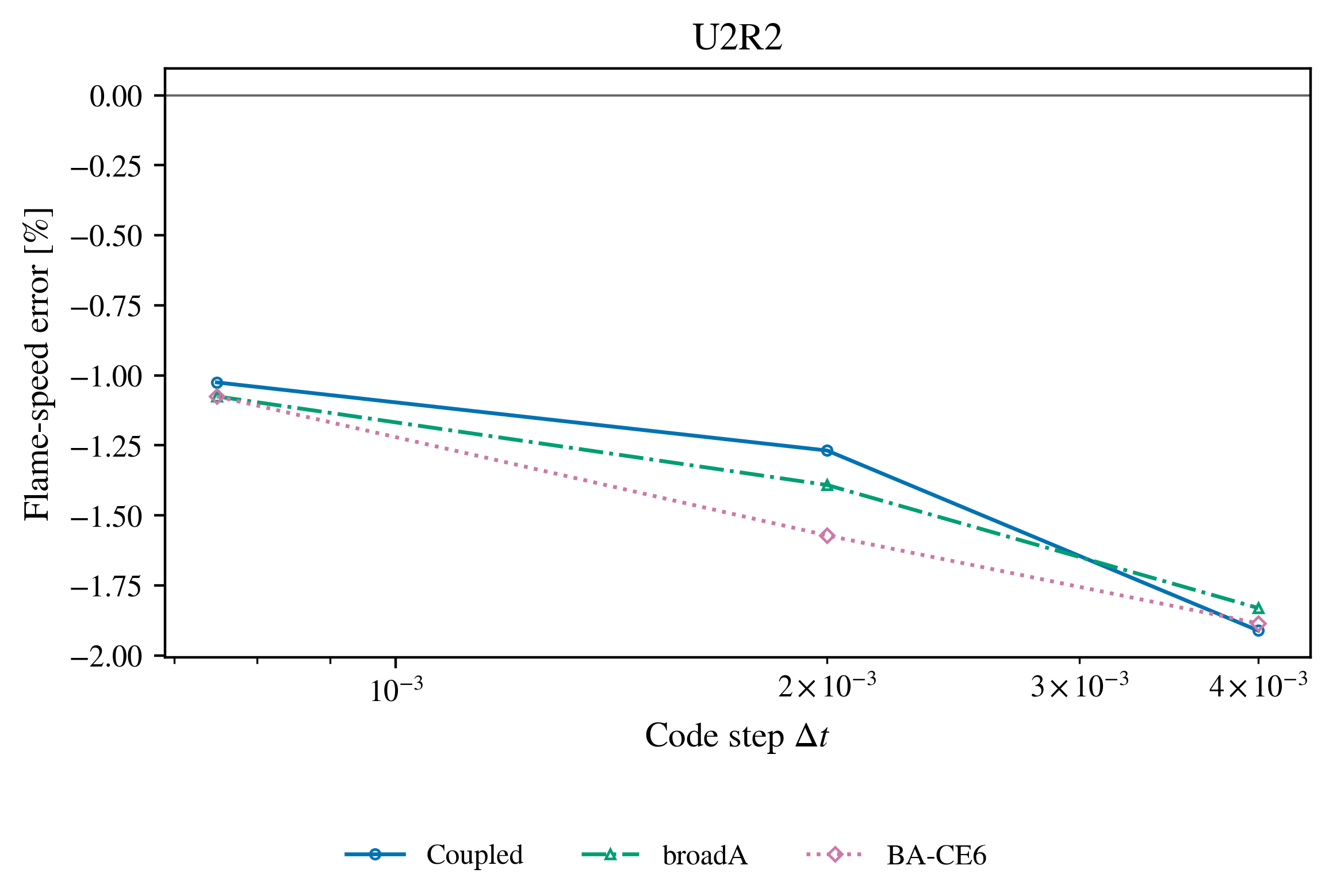
U2R2 flame errors. Adaptive rows finish where Strang fails. Small signed errors in the medium/coarse adaptive rows coexist with low front-fit linearity.
Do not interchange the older broadA campaign
The earlier full matrix compared coupled/Strang/default/broadA. Its broadA coarse U2R1 error is +3.717%, whereas the later BA-CE6 campaign’s rerun broadA gives +16.707%. Their \(R^2\) values are only 0.175 and 0.230. The later BA-CE6 value is +7.681% with \(R^2=0.248\). All are fixed-work, nonstationary fits. This report uses the later four-treatment campaign consistently and does not replace its broadA control with the more attractive older number. The difference has not been isolated into a unique cause.
H2/O2 detonation: fine-grid posterior matrix
The laboratory-frame fitted ZND setup uses 5000 cells over 12.5 mm,
\(\Delta x=2.5\,\mu\mathrm m\), initial shock at 2.5 mm and left BCFar matching
the downstream state. The fitted induction length is about \(50.04\,\mu\mathrm m\)
(about 20 cells). The same-grid reference is the observed-order time-limit
extrapolation of the coupled ESDIRK4 study,
This is not the equilibrium Cantera/SDToolbox CJ value
\(2836.381883789159\,\mathrm{m\,s^{-1}}\) and is not a spatially converged
continuum reference. Spatial convergence remains deferred. All 52 archived
rows have fitted speeds; front fits use \(4.0\le x_f\le8.25\) mm and have
\(R^2\ge0.999978\). The default column is the earlier default-Hill control,
not BA-CE6 or Balance. Every BA-CE6 entry is explicitly unrun.
| ODE | Code dt | Coupled | Strang | default | broadA | BA-CE6 |
|---|---|---|---|---|---|---|
| ESDIRK2 | 1e-07 | +0.030% | +0.027% | +0.027% | +0.027% | unrun |
| ESDIRK2 | 2e-07 | +0.135% | +0.073% | +0.073% | +0.076% | unrun |
| ESDIRK2 | 4e-07 | +0.456% | +0.242% | +0.242% | +0.244% | unrun |
| ESDIRK2 | 8e-07 | +1.295% | +0.311% | +0.420% | +0.589% | unrun |
| ESDIRK2 | 1.6e-06 | +16.627% | +19.380% | +19.915% | +20.039% | unrun |
| U2R1 | 1e-07 | +0.031% | +0.031% | +0.031% | +0.031% | unrun |
| U2R1 | 2e-07 | +0.134% | +0.125% | +0.125% | +0.118% | unrun |
| U2R1 | 4e-07 | +0.319% | +0.313% | +0.309% | +0.296% | unrun |
| U2R1 | 8e-07 | +0.745% | +0.693% | +0.712% | +0.735% | unrun |
| U2R2 | 1e-07 | -0.376% | -0.371% | -0.371% | -0.371% | unrun |
| U2R2 | 2e-07 | -0.183% | -0.313% | -0.313% | -0.316% | unrun |
| U2R2 | 4e-07 | -0.049% | -0.092% | -0.092% | -0.104% | unrun |
| U2R2 | 8e-07 | +0.360% | +0.943% | +1.026% | +1.017% | unrun |
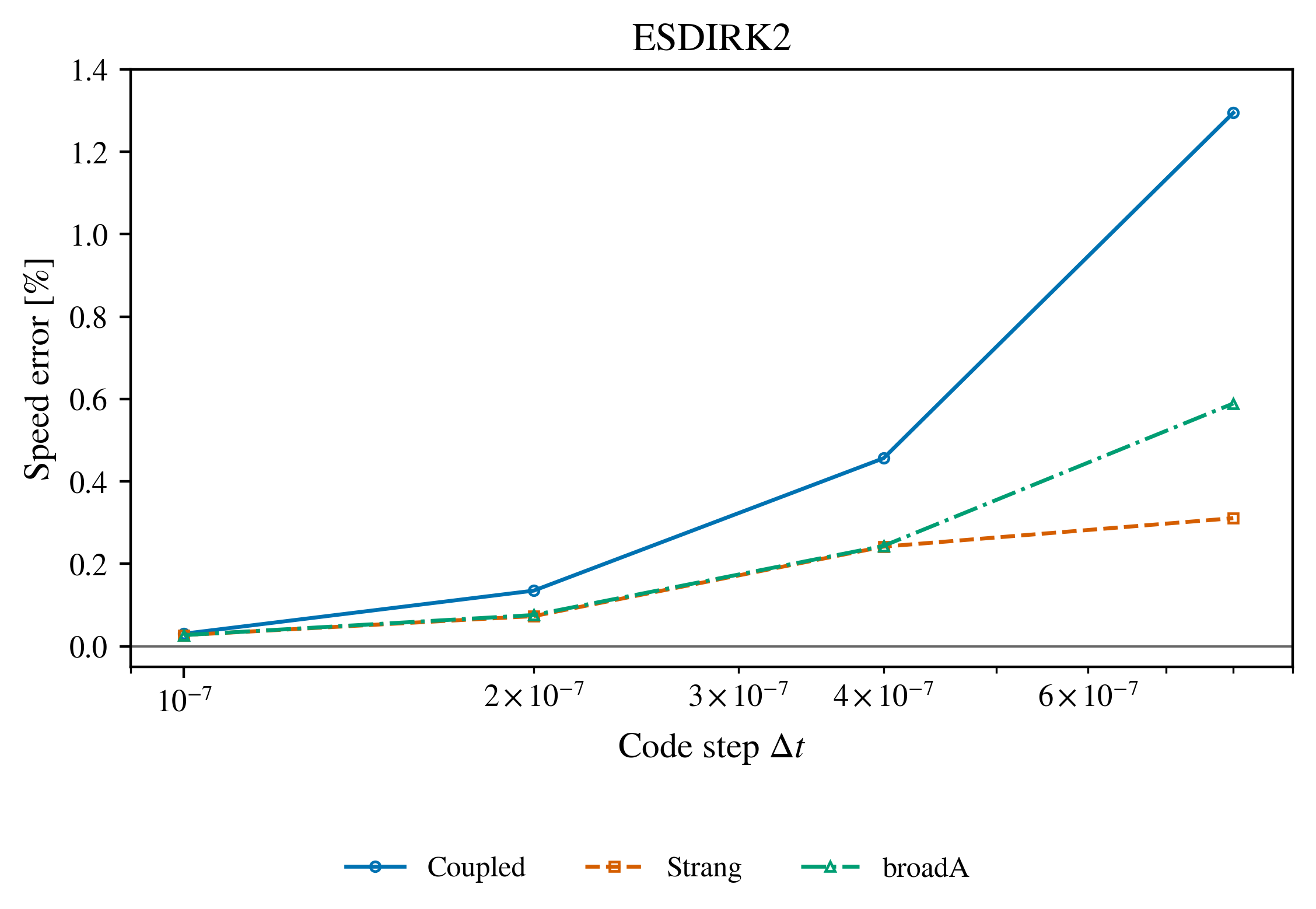
ESDIRK2 through \(8\times10^{-7}\). This zoom resolves the favorable Strang and broadA errors at useful timesteps without compressing them against the coarse-step breakdown. The complete larger-step view follows.
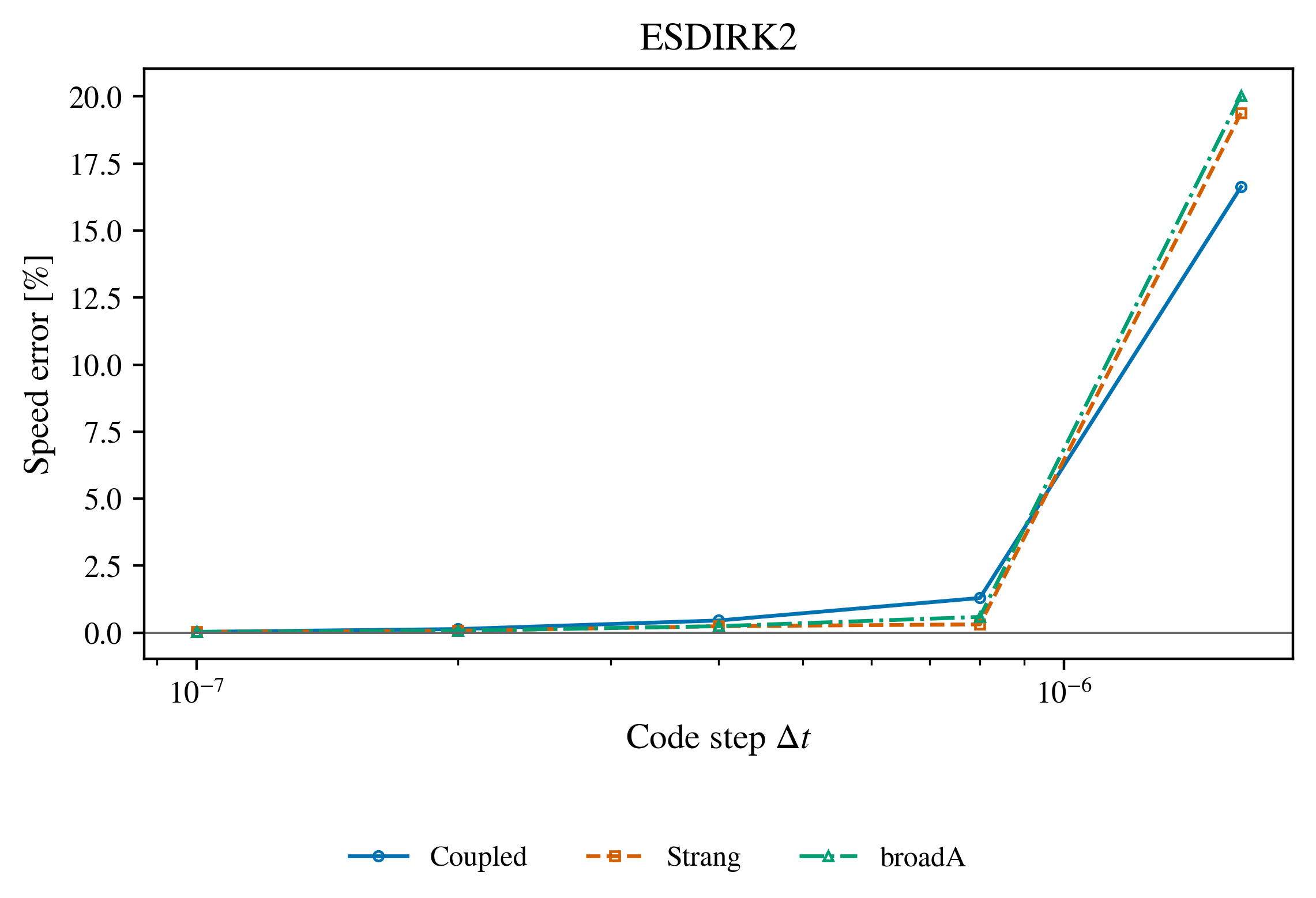
ESDIRK2 detonation errors. At \(8\times10^{-7}\), Strang and broadA improve on coupled. The \(1.6\times10^{-6}\) extension makes every treatment poor and dominates the vertical scale; use the table to resolve the smaller-step errors.
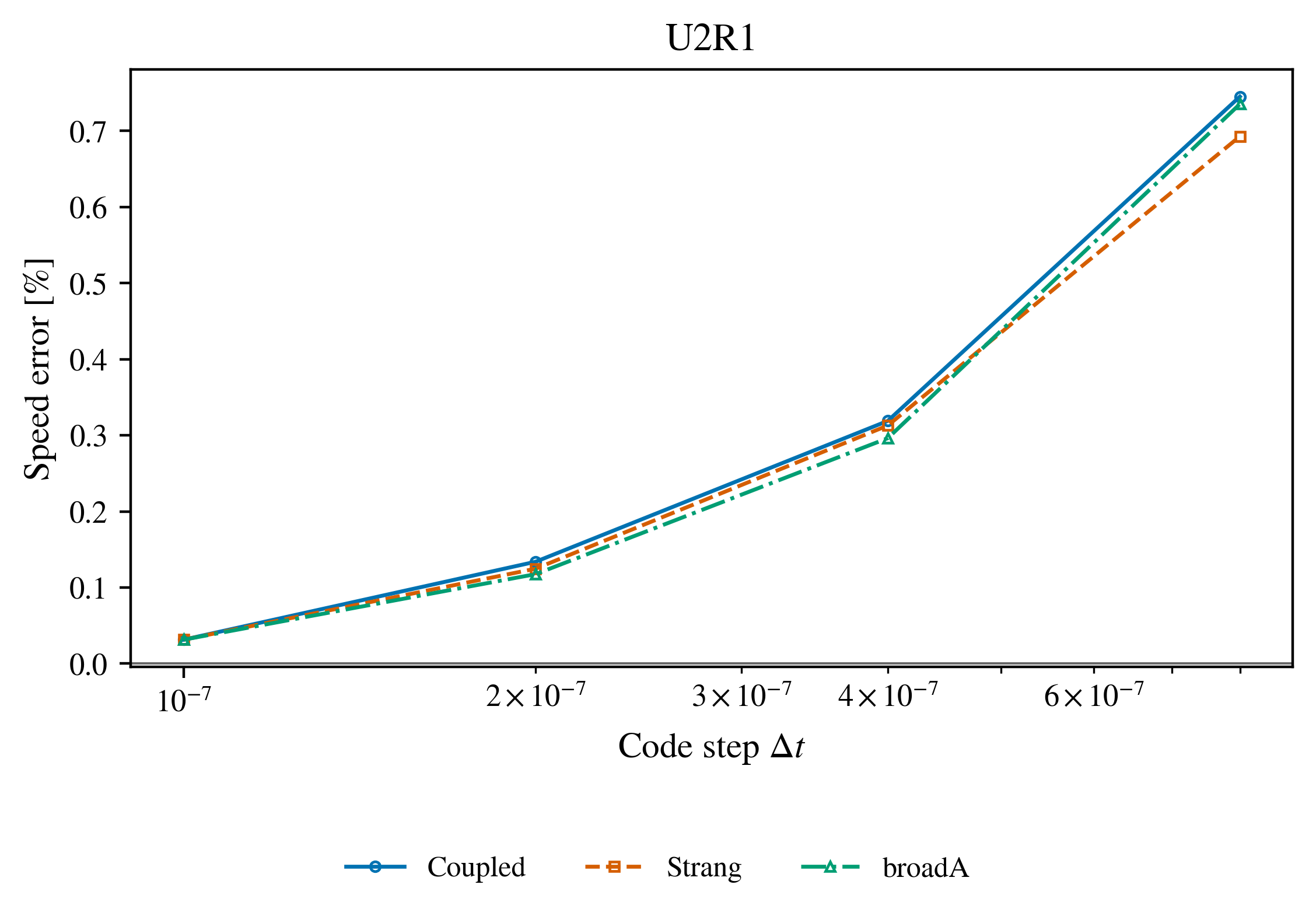
U2R1 detonation errors. Differences among treatments are much smaller than the timestep trend, so no large mixed-method accuracy advantage follows.
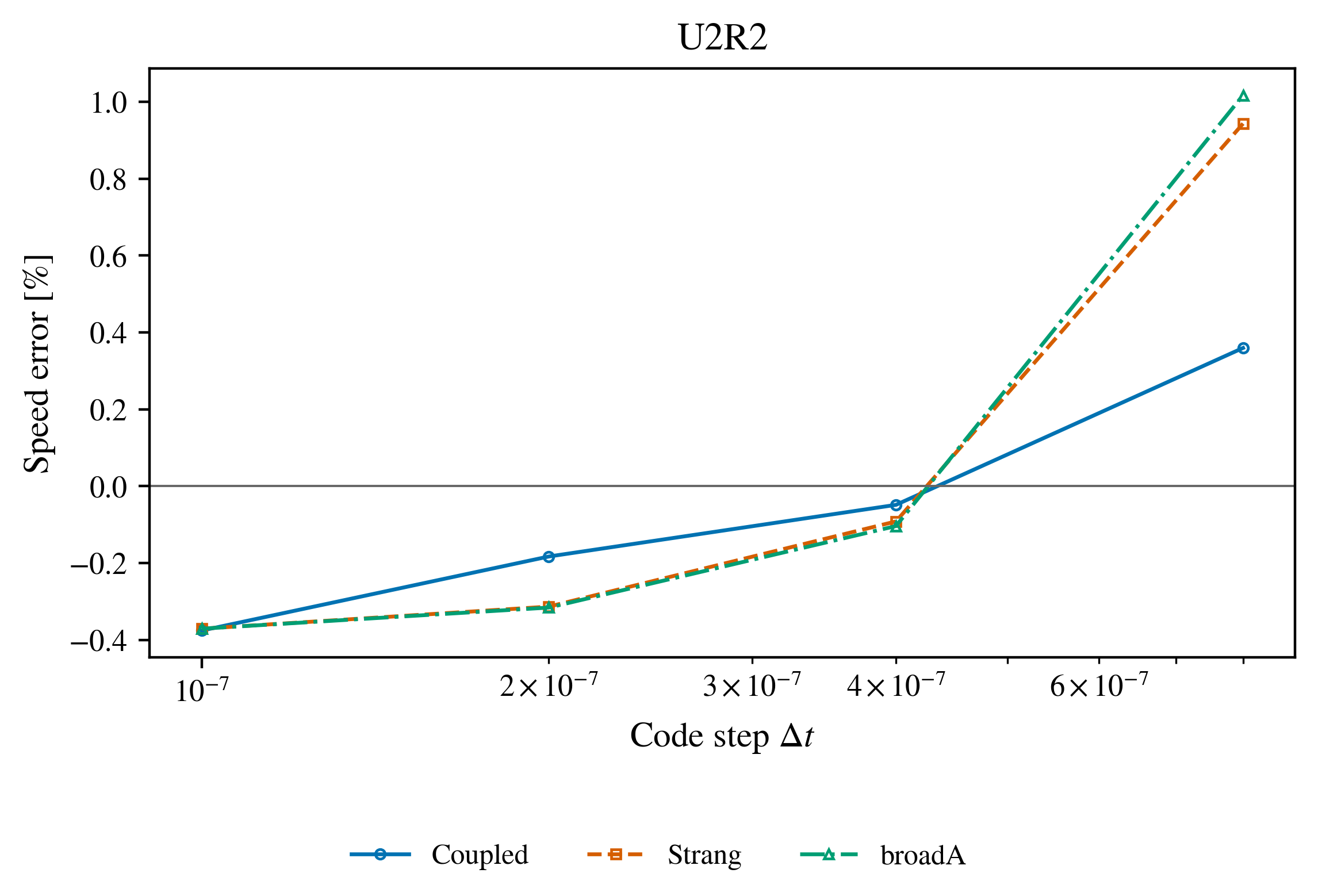
U2R2 detonation errors. At \(8\times10^{-7}\) the endpoint ordering reverses: coupled has +0.360% error versus +0.943% for Strang and +1.017% for broadA. A shock preference alone cannot guarantee the better temporal method.
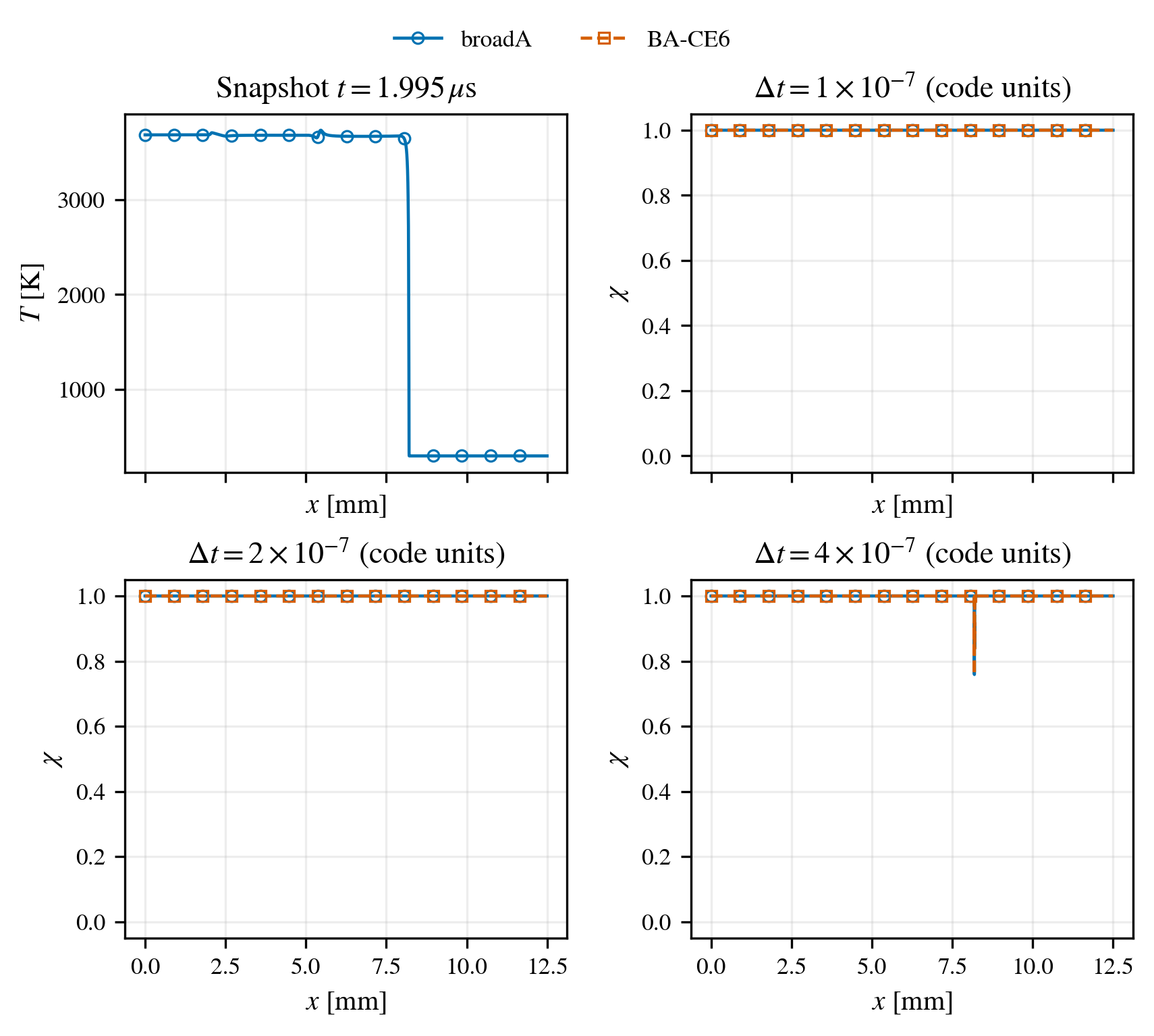
The available BA-CE6 detonation evidence is static. At the three annotated prospective steps, its selector overlaps broadA on this saved profile. This does not establish BA-CE6 speed, nonlinear convergence or runtime. Also note the convention: near-Strang means \(\chi\) near one, not zero.
Why n-heptane and what NTC means
The mechanism has the Seiser/Pitsch/Curran reduced LLNL lineage. LLNL’s short
mechanism descends from its older version-38 detailed mechanism, with 159
species and 770 reversible reactions; it is not the latest detailed LLNL
mechanism. LLNL mechanism description.
The actual DNDSR YAML used here contains 160 species and 1540 directed
reactions, as counted in the saved Cantera manifest. It has the existing
low-temperature thermodynamic extension, with constant endpoint heat capacities
below the original interval, to support the solver’s 1 K bound. This numerical
extension is not validation of reaction kinetics at cryogenic temperatures.
All reductions use the exact species order; the absorbed last species in this
case is c5h9o1-4, not nitrogen.
Chemicals represented
n-Heptane is the straight-chain saturated hydrocarbon
\(\mathrm{CH_3(CH_2)_5CH_3}\), with molecular formula \(\mathrm{C_7H_{16}}\);
its mechanism identifier is nc7h16. In this case it is gaseous fuel, not a
liquid spray. The fresh oxidizer is oxygen diluted by nitrogen. The initial
molar ratio is n-heptane : oxygen : nitrogen = 1 : 11 : 41.36,
corresponding to the stoichiometric mixture. The overall complete-oxidation
balance, not an elementary reaction in the kinetic mechanism, is
The model does not jump directly from fuel to final products: it evolves small radicals, fragments and oxygenated intermediates through many reactions. The following groups explain the fields plotted in this study and the low-temperature pathways relevant to ignition:
| Group | Representative exact identifiers | Meaning in this study |
|---|---|---|
| Fuel and oxidizer | nc7h16, o2 | Gaseous n-heptane and molecular oxygen. |
| Bath gas | n2 | Nitrogen diluent; contributes to mixture thermodynamics/transport and collision-partner effects, but is the only nitrogen-bearing species. |
| Major products and smaller molecules | co2, h2o, co, h2, ch4 | Carbon dioxide and water are principal complete-oxidation products; CO, hydrogen and methane also participate in the finite-rate network. |
| Small radical pool | h, o, oh, ch3, hco | Hydrogen, oxygen, hydroxyl, methyl and formyl radicals carry the fast reaction chains. OH is shown in the profile comparisons. |
| Hydrogen peroxide chemistry | ho2, h2o2 | Hydroperoxyl radical and hydrogen peroxide connect radical storage/production to ignition. |
| Small oxygenated intermediates | ch2o, ch3cho, ch3oh, ch3coch3 | Formaldehyde, acetaldehyde, methanol and acetone; formaldehyde is a useful plotted marker of the prepared and reacting kernel. |
| Heptyl radicals | c7h15-1 through c7h15-4 | Fuel-derived radicals with different radical positions, formed after hydrogen abstraction. |
| Peroxy radicals and hydroperoxides | c7h15o2-1, c7h15o2h-1 and their listed isomers | Oxygen addition creates peroxy chemistry; radicals and stable hydroperoxides are distinct species. |
| Hydroperoxyalkyl pathway | c7h14ooh1-3, c7h14ooh1-3o2 and their listed isomers | Commonly called QOOH and oxygen-added QOOH families; routes toward low-temperature chain branching. |
| Ketohydroperoxides | nc7ket13, nc7ket23 and the other nc7ket* entries | Intermediates whose formation/decomposition can produce OH and promote branching. |
| Competing fragmentation/oxygenate pathways | c7h14-1, c7h14o1-3, plus smaller C2–C6 species | Olefins, cyclic ethers and fragments connect alternative propagation pathways to the small-molecule network. |
The pathway roles follow the parent mechanism’s reaction-class discussion; the competition between branching and alternative pathways motivates the NTC interpretation, but the current CFD plots are not a reaction-path flux or sensitivity analysis. Curran et al., reaction classes and low-temperature branching.
Exact inventory used here: Cantera 3.2.0 loads 160 species, 1540
irreversible reaction entries, and zero entries marked reversible from the
run’s YAML. These are directed kinetic entries; do not report them as 1540
reversible reaction pairs. The historical LLNL description counts 770
reversible reactions and names its reduction “159 species”; the local filename
retains that historical name, but the loaded phase count is authoritative.
The mechanism includes elements C, H, O and N. Since n2 is its only
nitrogen-bearing species, it cannot predict NO/NO2 chemistry. It is also not a
liquid-evaporation, droplet or soot model.
The machine-readable inventory
records every exact name, elemental composition and one-based phase position,
with mechanism SHA-256
67c3c3b79b328f1942294336a8798d047b51407cac698e7649ed6fc4344f1cef.
The complete species list is below, in YAML phase order. Names distinguish
positional/electronic isomers and must not be merged merely because their
elemental formulas coincide; for example, ch2 and ch2(s) are separate
entries. The final absorbed (dependent) closure species is c5h9o1-4.
Complete species list
| YAML positions | Exact species names |
|---|---|
| 1–8 | n2, ch3, h, ch4, h2, oh, h2o, o |
| 9–16 | c2h6, c2h5, hco, co, co2, o2, h2o2, ho2 |
| 17–24 | c2h4, ch3oh, ch2oh, ch3o, ch2o, c2h2, c2h3, c2h |
| 25–32 | hcco, ch2, ch, ch2co, ch2(s), pc2h4oh, ch3co, ch3cho |
| 33–40 | c3h5-s, c3h4-p, c3h5-a, c3h6, c3h4-a, ch3chco, c3h5-t, c4h6 |
| 41–48 | nc3h7, ic3h7, c3h8, c5h9, c4h7, c4h8-1, sc4h9, pc4h9 |
| 49–56 | ch3coch3, ch3coch2, c2h5co, c2h5cho, c5h10-1, ch2cho, c5h11-1, c5h11-2 |
| 57–64 | c2h5o, c2h5o2, ch3o2, ch3o2h, c3h2, o2c2h4oh, c2h4o2h, c2h3co |
| 65–72 | c2h3cho, c3h5o, c3h6o1-2, c3h6ooh1-2, c3h6ooh2-1, nc3h7o, ic3h7o, nc3h7o2 |
| 73–80 | ic3h7o2, c4h7o, c4h8ooh1-3o2, c4h8ooh1-3, nc4ket13, c4h8ooh1-2, c4h8o1-3, pc4h9o2 |
| 81–88 | c3h3, hocho, c2h3o1,2, nc3h7cho, nc3h7co, c3h6cho-2, ch2ch2coch3, c2h5coch2 |
| 89–96 | c2h5coc2h4p, nc3h7coch2, nc4h9cho, nc4h9co, hoch2o, c6h13-1, c6h12-1, c6h11 |
| 97–104 | nc7h16, c7h15-1, c7h15-2, c7h15-3, c7h15-4, c7h15o2-1, c7h15o2h-1, c7h15o2-2 |
| 105–112 | c7h15o2h-2, c7h15o2-3, c7h15o2h-3, c7h14-1, c7h14-2, c7h14-3, c7h13, c7h15o2-4 |
| 113–120 | c7h15o-1, c7h15o-2, c7h15o-3, c7h14ooh1-2, c7h14ooh1-3, c7h14ooh1-4, c7h14ooh2-3, c7h14ooh2-4 |
| 121–128 | c7h14ooh2-5, c7h14ooh3-1, c7h14ooh3-2, c7h14ooh3-4, c7h14ooh3-5, c7h14ooh3-6, c7h14ooh4-2, c7h14ooh4-3 |
| 129–136 | c7h14o1-3, c7h14o1-4, c7h14o2-4, c7h14o2-5, c7h14o3-5, c7h14ooh1-3o2, c7h14ooh2-3o2, c7h14ooh2-4o2 |
| 137–144 | c7h14ooh2-5o2, c7h14ooh3-1o2, c7h14ooh3-2o2, c7h14ooh3-4o2, c7h14ooh3-5o2, c7h14ooh3-6o2, c7h14ooh4-2o2, c7h14ooh4-3o2 |
| 145–152 | nc7ket13, nc7ket23, nc7ket24, nc7ket25, nc7ket31, nc7ket32, nc7ket34, nc7ket35 |
| 153–160 | nc7ket36, nc7ket42, nc7ket43, nc4h9coch2, c4h7ooh1-4, c5h9ooh1-4, c4h7o1-4, c5h9o1-4 |
NTC behavior
NTC means negative temperature coefficient. Over an intermediate initial temperature interval, increasing temperature reduces effective low-temperature reactivity and increases ignition delay. Oxygen-addition/isomerization routes toward chain branching compete with decomposition and propagation routes; their changing balance can make ignition delay non-monotonic even though individual elementary rates accelerate. This concerns induction chemistry, not a negative temperature response of the already burned gas. Curran et al., n-heptane oxidation.
The existing Cantera scan, using this exact YAML and adiabatic constant-volume reactors, demonstrates at 20 atm a main-ignition delay increase from 0.977 ms at 830 K to 2.489 ms at 960 K. Ignition is defined there by peak \(\mathrm dT/\mathrm dt\), not the CFD kernel’s 2000 K crossing. The two-scale CFD starts after chemical preconditioning: its short hot continuation is not by itself a fresh demonstration of NTC.
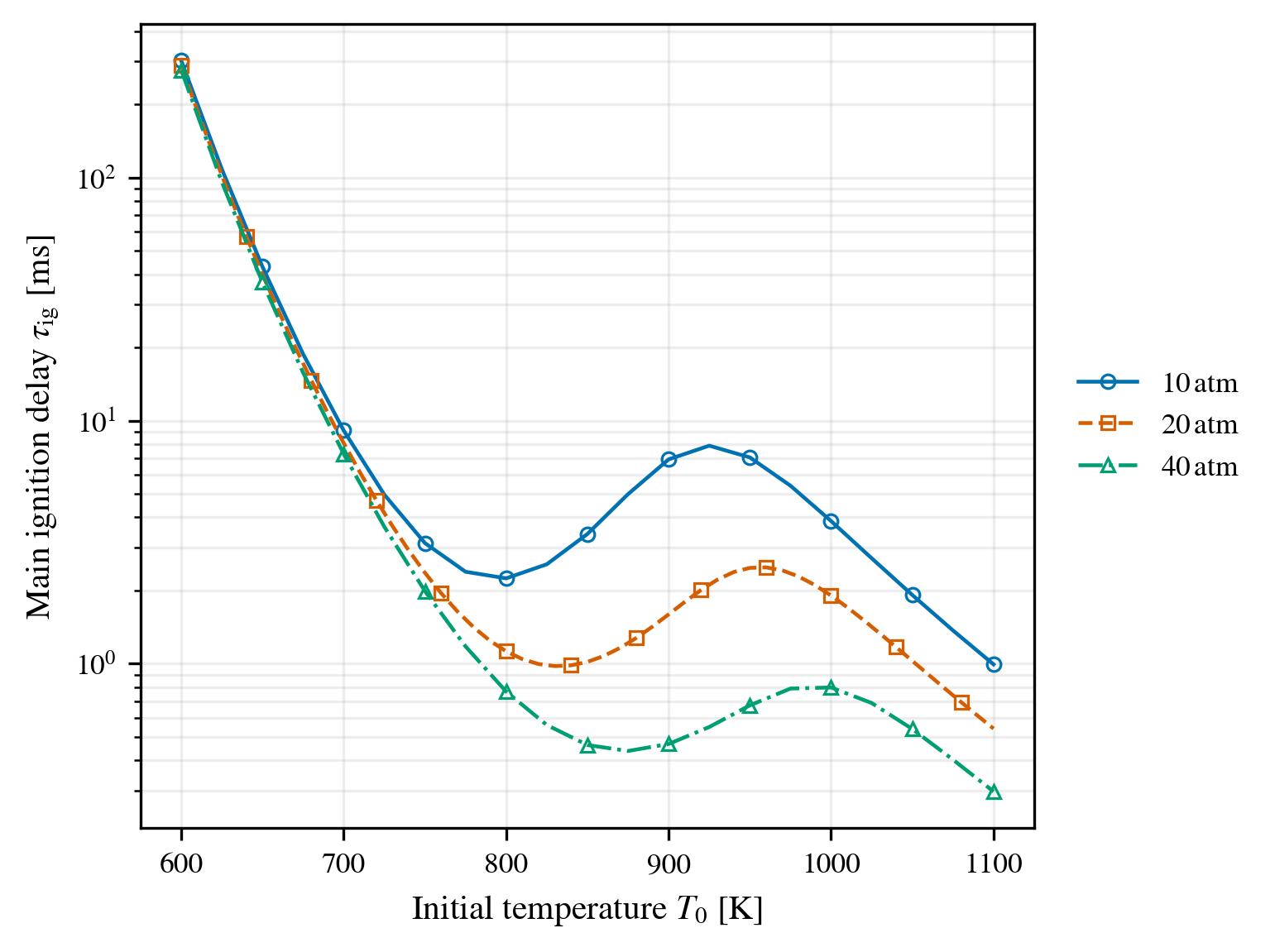
Homogeneous ignition-delay curves. The ascending portions demonstrate the NTC interval in the exact study mechanism; pressure shifts the interval and delay. This is a mechanism/design test, not a CFD accuracy reference.
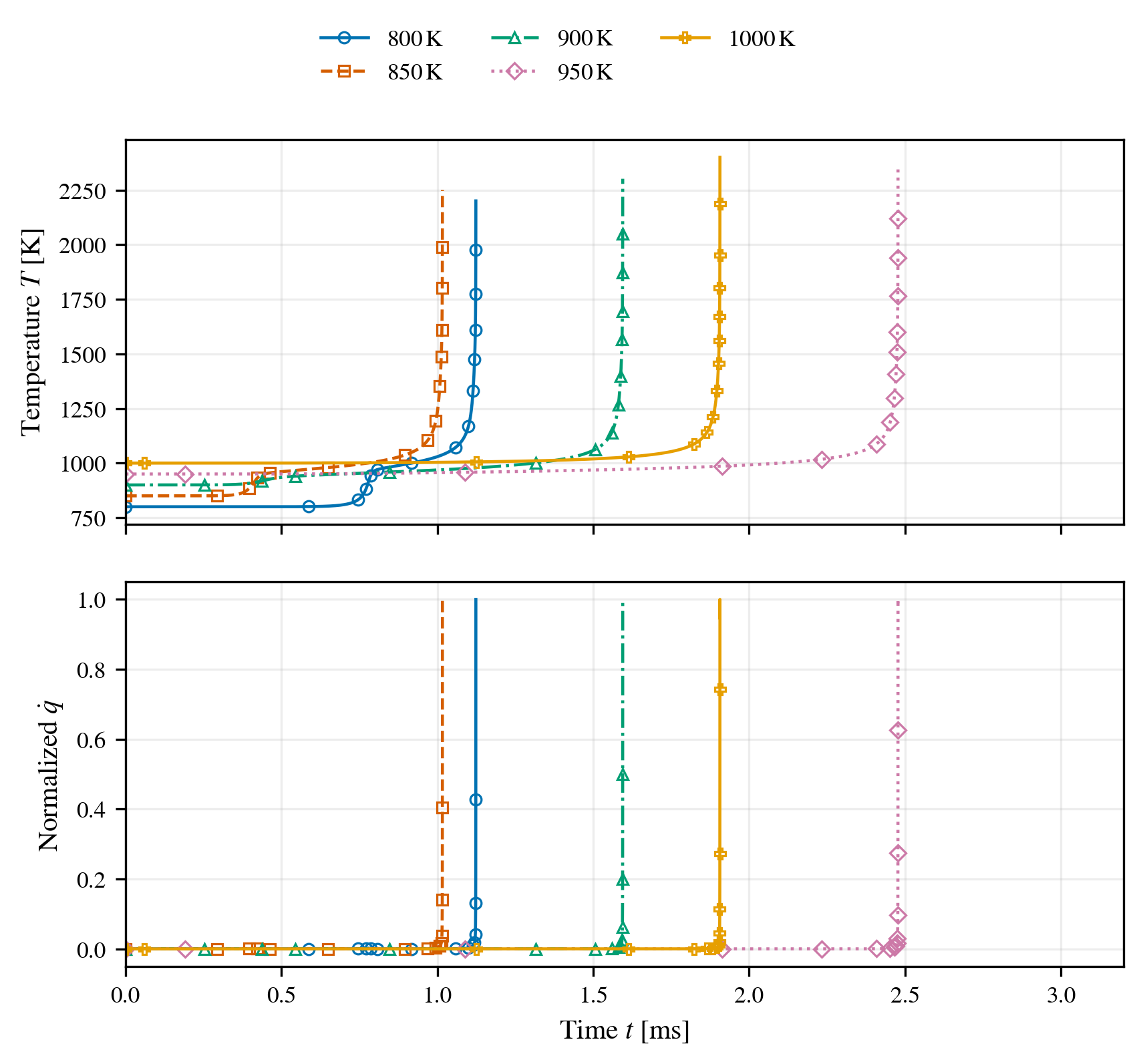
Low-temperature and main ignition. The separated heating events explain why a single fixed physical step can face slow induction and a rapid runaway. Each heat-release trace is normalized separately; amplitudes are not comparable.
The earlier hot n-heptane posterior matrix had 20 completed rows, but no common finely resolved truth and different coarse-step end times. It demonstrated cost/robustness rather than a clear accuracy win: at code \(1.6\times10^{-3}\), coupled and broadA capped 3/7 physical steps, while Strang and BA-CE6 converged 7/7. Typical large-step amortized cost was about 2 s per printed inner iteration for coupled/broadA versus 0.9–1.0 s for Strang/BA-CE6 on 64 ranks. Those costs are configuration-specific.
Ignition plus front: physical preparation and reference trajectory
The goal is to put a narrow diffusion-active reacting interface and a broader chemically sensitive ignition kernel in the same one-dimensional domain. Use a 10 mm closed tube, 1200 cells (\(8.333\,\mu\mathrm m\)), periodic transverse width \(25\,\mu\mathrm m\), initially 20 atm and zero velocity. Streamwise walls reflect waves; boundary interaction is intentional. This is not a free-flame speed problem and the seeded interface is not an exact steady flame.
The fresh stoichiometric mixture before preparation is
$$ Y_{\mathrm{N_2}}=0.7192878080,\quad Y_{\mathrm{O_2}}=0.2185055960,\quad Y_{\mathrm{nC_7H_{16}}}=0.0622065960. $$Its preparation-temperature profile is
$$ T_{\rm prep}(x)=750\,\mathrm K+80\,\mathrm K \exp\left[-\left(\frac{x-7\,\mathrm{mm}}{1.8\,\mathrm{mm}}\right)^2\right]. $$Evolve those parcels isobarically for 1.3273 ms. Separately equilibrate the 750 K fresh mixture at fixed enthalpy/pressure to make the burned seed. Blend prepared and burned compositions and enthalpy, using a smooth transition:
$$ \xi=\operatorname{clip}\left(\frac{x-2\,\mathrm{mm}}{0.2\,\mathrm{mm}}+\frac12,0,1\right), \quad w=\xi^3(10-15\xi+6\xi^2), $$$$ Y(x)=(1-w)Y_b+wY_a(x),\qquad \mathfrak h(x)=(1-w)\mathfrak h_b+w\mathfrak h_a(x). $$Here \(a,b\) mean aged and burned, and \(\mathfrak h\) is mixture specific enthalpy, not the pressure sensor. Recover temperature from \((\mathfrak h,p,Y)\) with Cantera; interpolate the common \(T/Y\) table in the solver and derive density and conservative energy through its EOS. No arbitrary radical mass fractions are inserted. The actual initial kernel maximum is 1278.41 K, while the burned seed is about 2605.52 K; 750–830 K is the preparation range, not the final CFD initial-temperature range.
Full Strang/ESDIRK2 completes a 0–25 μs pilot and a verified restart continuation
to 40 μs, with code ceiling \(10^{-4}\) (0.263852 μs). The first run has 95/95
converged physical steps; the continuation adds 62/62. The comparison uses
P1 FV, corrected reactive transport, rhsFPPMode=2, 10–400 inner iterations,
pseudo-CFL ramp 1→100 in ten iterations and density stopping ratio \(10^{-3}\).
The combined profile history removes the overlapped restart tail.
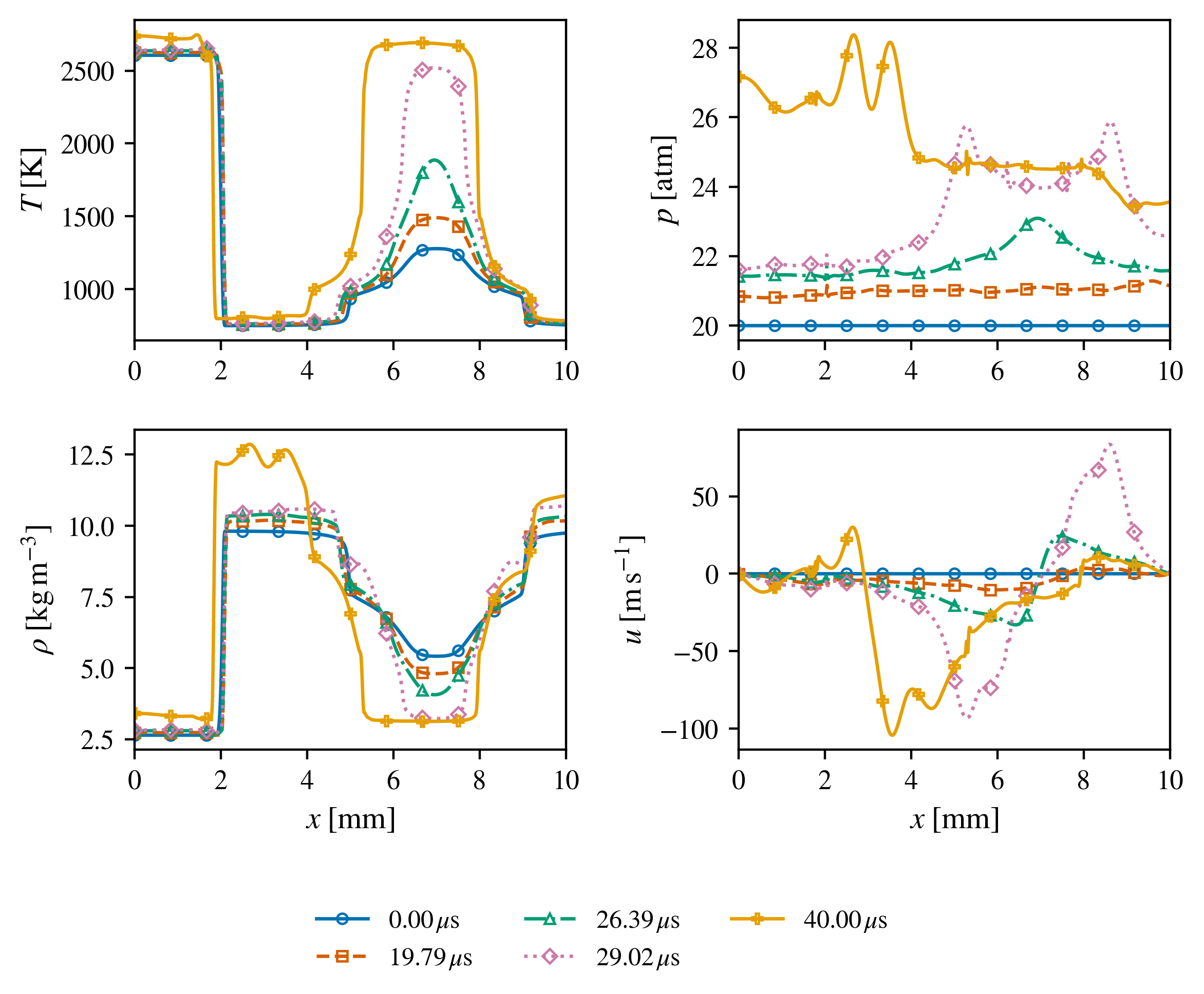
Small-step full-Strang trajectory through 40 μs. Temperature, pressure, density and velocity separate the reacting interface near 2 mm from kernel runaway near 7 mm. Expansion and pressure waves show this is not a homogeneous constant-volume reactor. These profiles are a practical baseline, not exact truth.
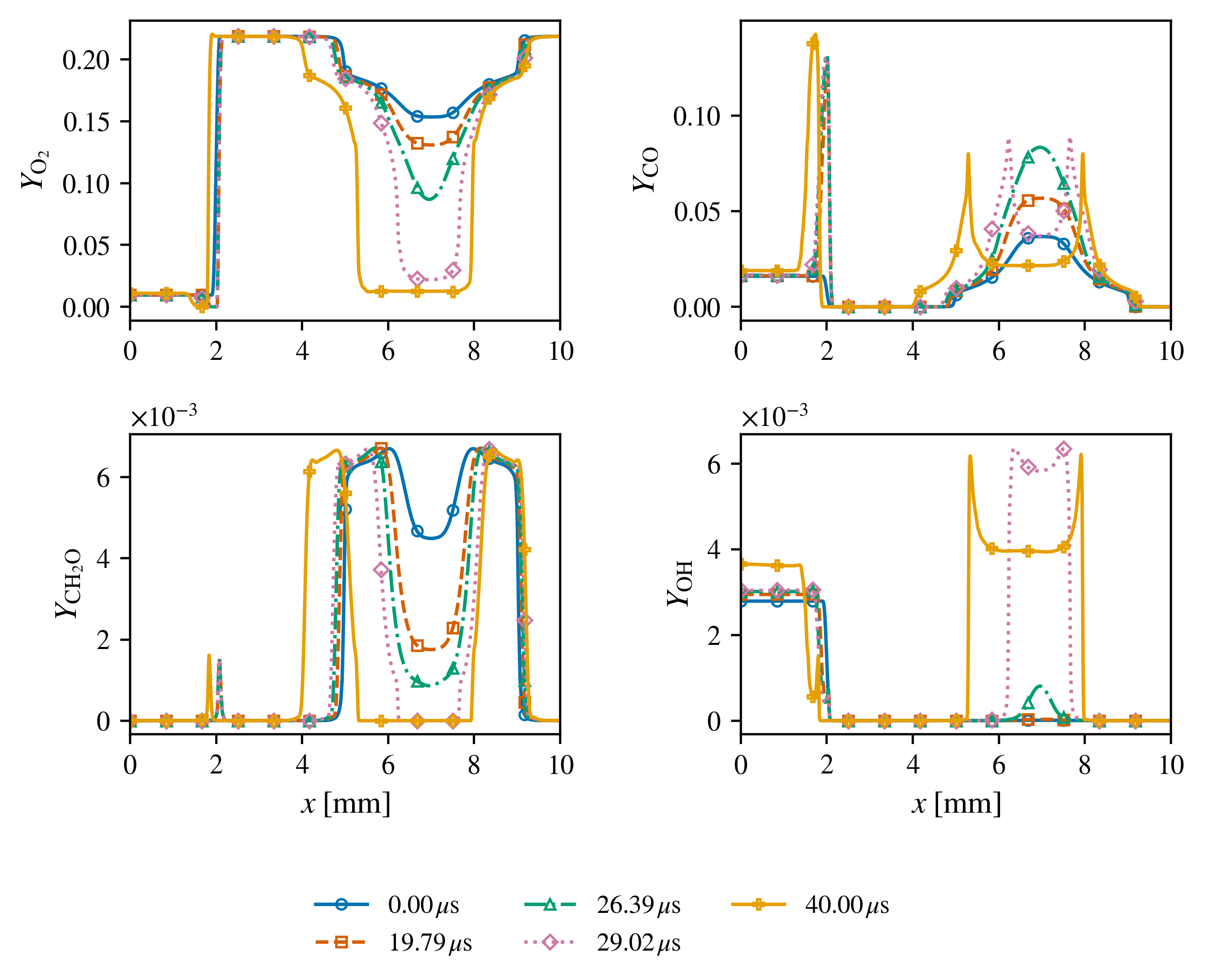
Species evolution on the same slices. Oxygen consumption, formaldehyde loss, evolving CO and increased OH identify the main kernel reaction. Most original fuel was already transformed by preparation, so fuel alone is a poor runaway marker.
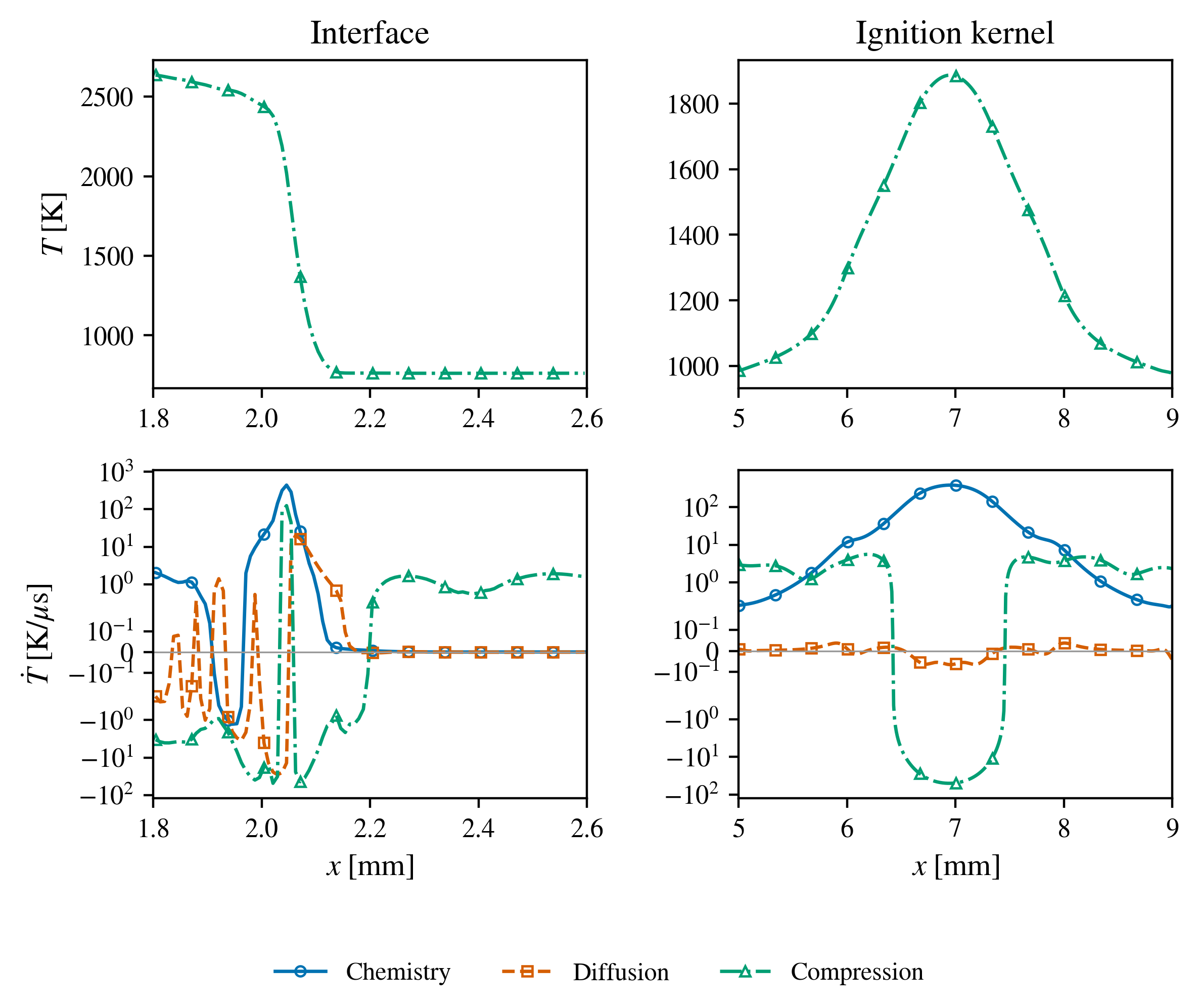
Cell-mean budget estimates near the runaway. Molecular diffusion matters locally at the narrow interface; chemical heating and flow compression/expansion dominate much of the kernel. These offline estimates motivate regional splitting, but do not prove causality by removing transport from the CFD.
Short-window comparison: interface and ignition errors
Every comparison starts from the same saved step-90 state at
23.74670185 μs, ends at 32 μs, and uses serial 64-rank execution on cs.
The provisional reference advances that restart with Strang at code
\(5\times10^{-5}\) (0.131926 μs), 63 physical steps and 126 converged stages.
It refines only the short window; it does not remove error accumulated before
the common restart or establish spatial convergence.
Define interface \(I=[1,3)\) mm (240 cells) and ignition kernel \(K=[3,10]\) mm (840 cells). On this uniform grid, for either region \(R\),
$$ E_{\rm mean}^{R}=\frac1{N_R}\sum_{i\in R}|T_i-T_{i,\rm ref}|,\qquad E_{\rm max}^{R}=\max_{i\in R}|T_i-T_{i,\rm ref}|. $$Errors are endpoint differences in kelvin at fixed spatial cells. No front alignment is applied; displacement of a steep interface contributes to error. The kernel includes its cooler shoulders, not only the hottest reacting cells. Mean error is not signed bias, and a small mean can hide a large local maximum.
What does zero error mean? In these temperature bar charts, the zero is defined by the Strang \(\Delta t_{\rm code}=5\times10^{-5}\) endpoint profile, not by an exact solution or Cantera reactor. Thus \(\Delta T_i=T_i-T_{i,\rm ref}\). An exactly zero mean or maximum absolute difference means every sampled temperature in that region matches the reference at 32 μs; positive and negative errors cannot cancel. It says nothing by itself about other fields, earlier times, or agreement with the continuum solution. The reference has zero error against itself by construction. Rounded displayed zeros need not mean bitwise identity.
What is the dotted “reference refinement” line? It is the same regional mean or maximum absolute temperature difference, but between the two Strang controls at code steps \(10^{-4}\) and \(5\times10^{-5}\). Both start from the same checkpoint, on the same mesh, and end at 32 μs. This measures sensitivity to halving the reference timestep. It is not a fourth/fifth method’s result, not a convergence tolerance, and not the unknown error of the finer run. The plot legend now explicitly names the two Strang steps.
| Dotted-line quantity | Interface [K] | Ignition kernel [K] |
|---|---|---|
| Mean absolute Strang step-halving difference | 7.66 | 1.52 |
| Maximum absolute Strang step-halving difference | 183.29 | 30.12 |
A bar below the dotted line is closer to the fine reference than the coarser Strang control is; it is not thereby proven more physically accurate. Two resolutions alone neither establish an asymptotic order nor provide a rigorous error bound. No Richardson correction or extrapolated truth is used here.
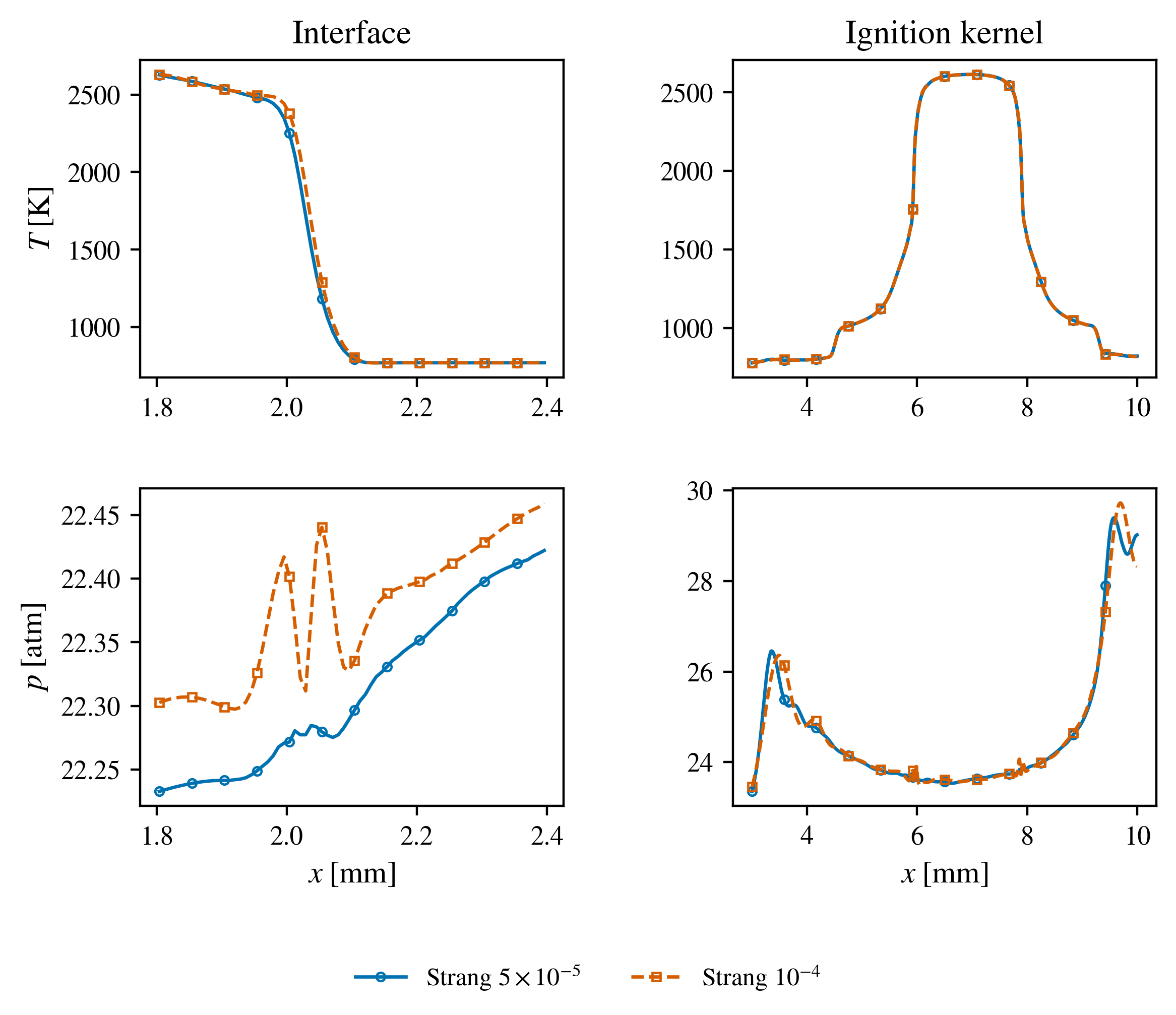
Reference sensitivity at 32 μs. Strang at \(10^{-4}\) versus \(5\times10^{-5}\) differs by interface mean/max 7.66/183.29 K, and kernel mean/max 1.52/30.12 K. This is an empirical refinement difference, not a rigorous error bound, and prevents overinterpreting small improvements.
Matched actual code step \(4\times10^{-4}\)
All four methods use seven full steps of 1.055409 μs and a common final shortened step: eight physical steps and sixteen implicit stages. Physical CFL 500 does not clip their histories. The earlier CFL-200 runs with the same nominal ceiling had different actual steps and are kept separately in the study report, not mixed into this table.
| Treatment | Interface mean / max [K] | Kernel mean / max [K] | Stages converged / capped | Wall [min] |
|---|---|---|---|---|
| Coupled | 18.04 / 293.91 | 44.13 / 684.48 | 16 / 0 | 16.34 |
| Strang | 19.43 / 575.75 | 11.60 / 346.22 | 16 / 0 | 7.69 |
| broadA | 18.45 / 365.36 | 14.20 / 298.20 | 14 / 2 | 38.61 |
| Balance | 16.85 / 378.28 | 10.54 / 251.70 | 16 / 0 | 8.96 |
The broadA endpoint is shown diagnostically: one physical step contains two capped stages, so its errors are not accepted as fully converged evidence. Balance has no snapped fully coupled cells in the last frozen field: 2.0% mixed, 98.0% Strang, mean \(1-\chi=0.00701\). broadA has 1.33% coupled, 16.08% mixed and 82.58% Strang, mean \(1-\chi=0.06951\). These are whole-domain cell fractions, not fractions of heat release or runtime.
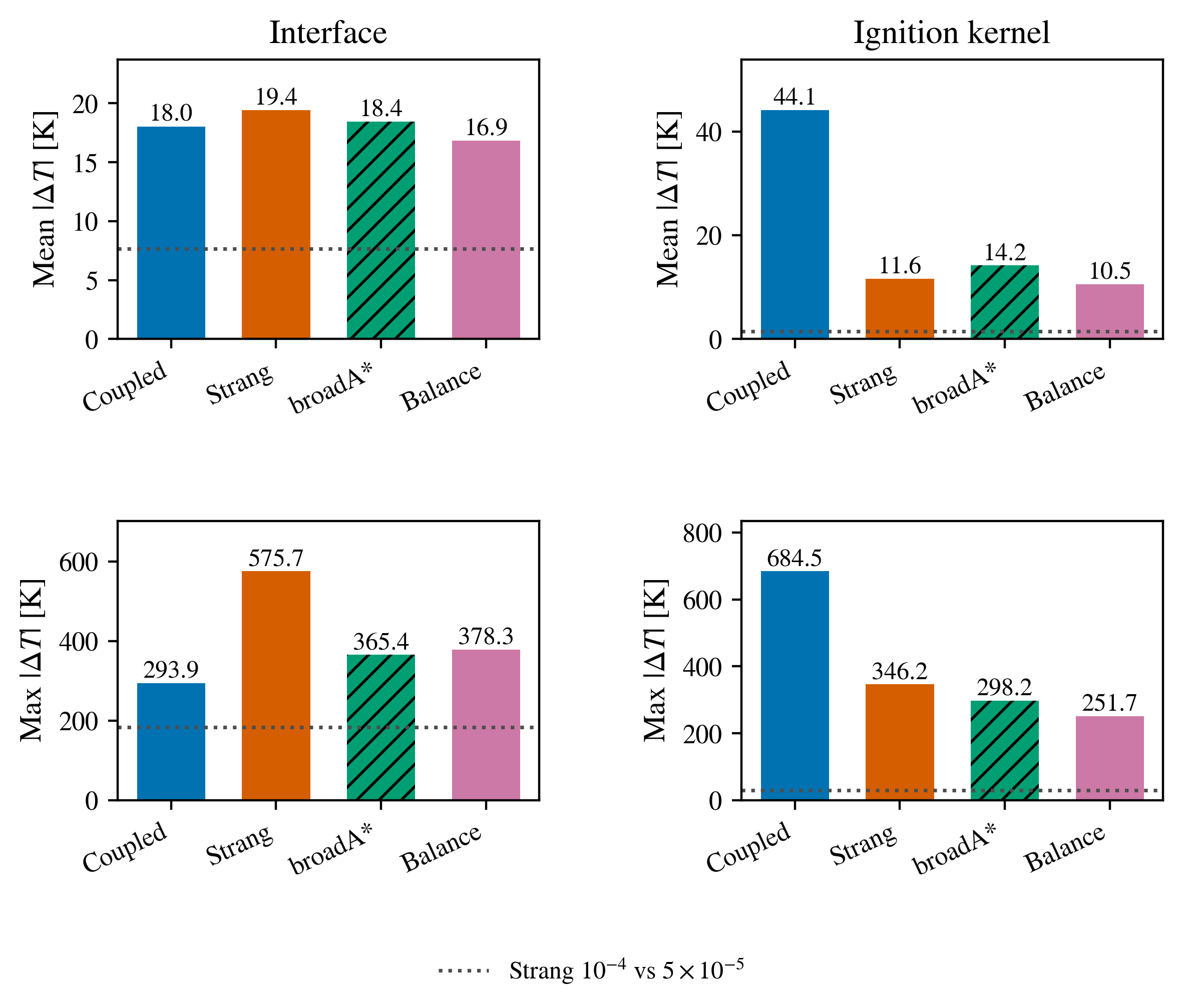
The key regional error comparison. Hatched broadA bars denote capped stages. Dotted levels are the separate reference-refinement differences. Here \(\Delta T=T-T_{\rm ref}\); the zero baseline is agreement with the fine Strang endpoint, not exact physical truth. Balance reduces the kernel mean error by about 76% and its maximum by about 63% relative to coupled, but coupled has the smallest interface maximum.
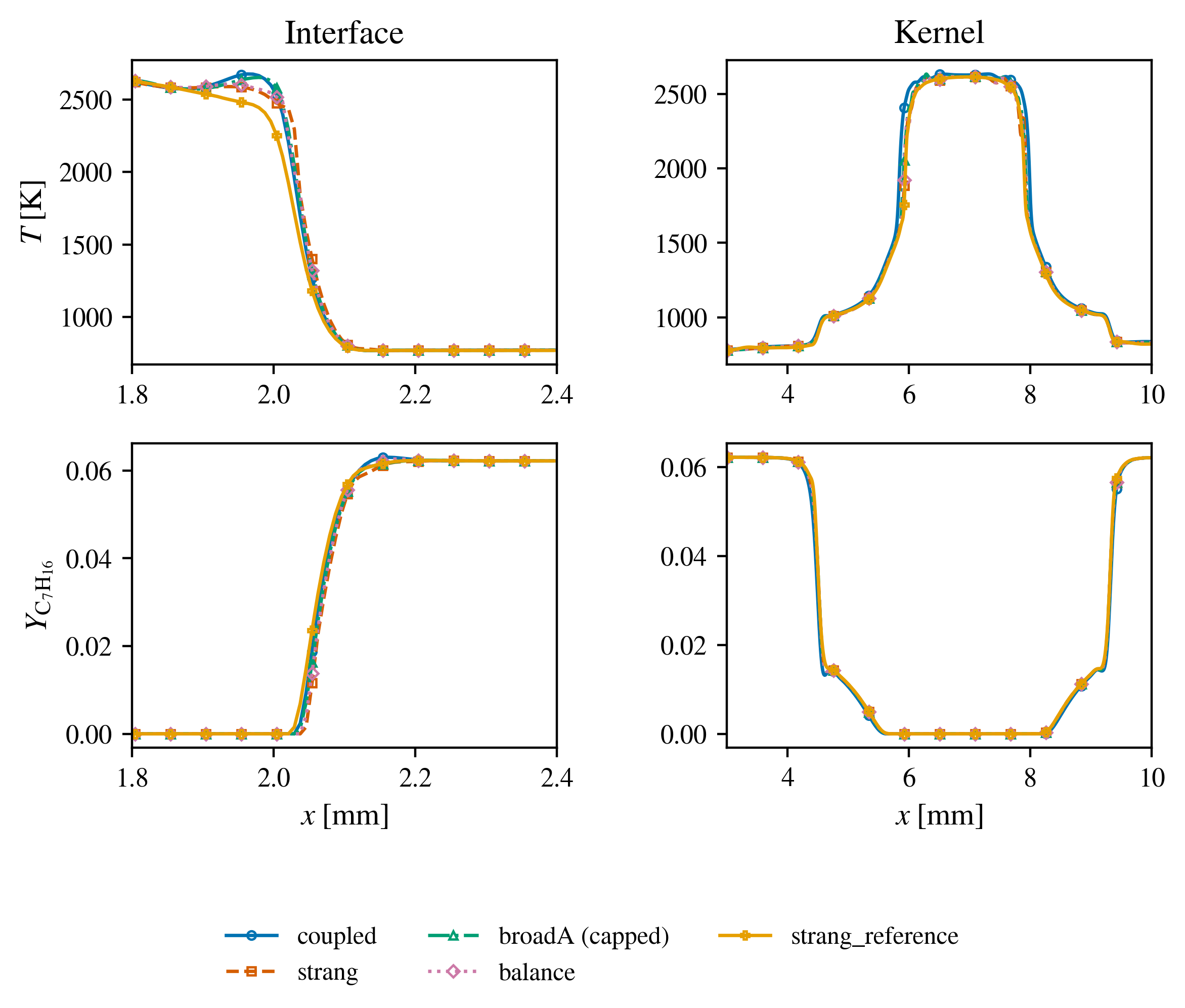
Temperature and fuel at the matched endpoint. The interface and kernel are separately enlarged; the fine Strang curve is the provisional reference. Localized peak errors arise near steep fronts and kernel shoulders.
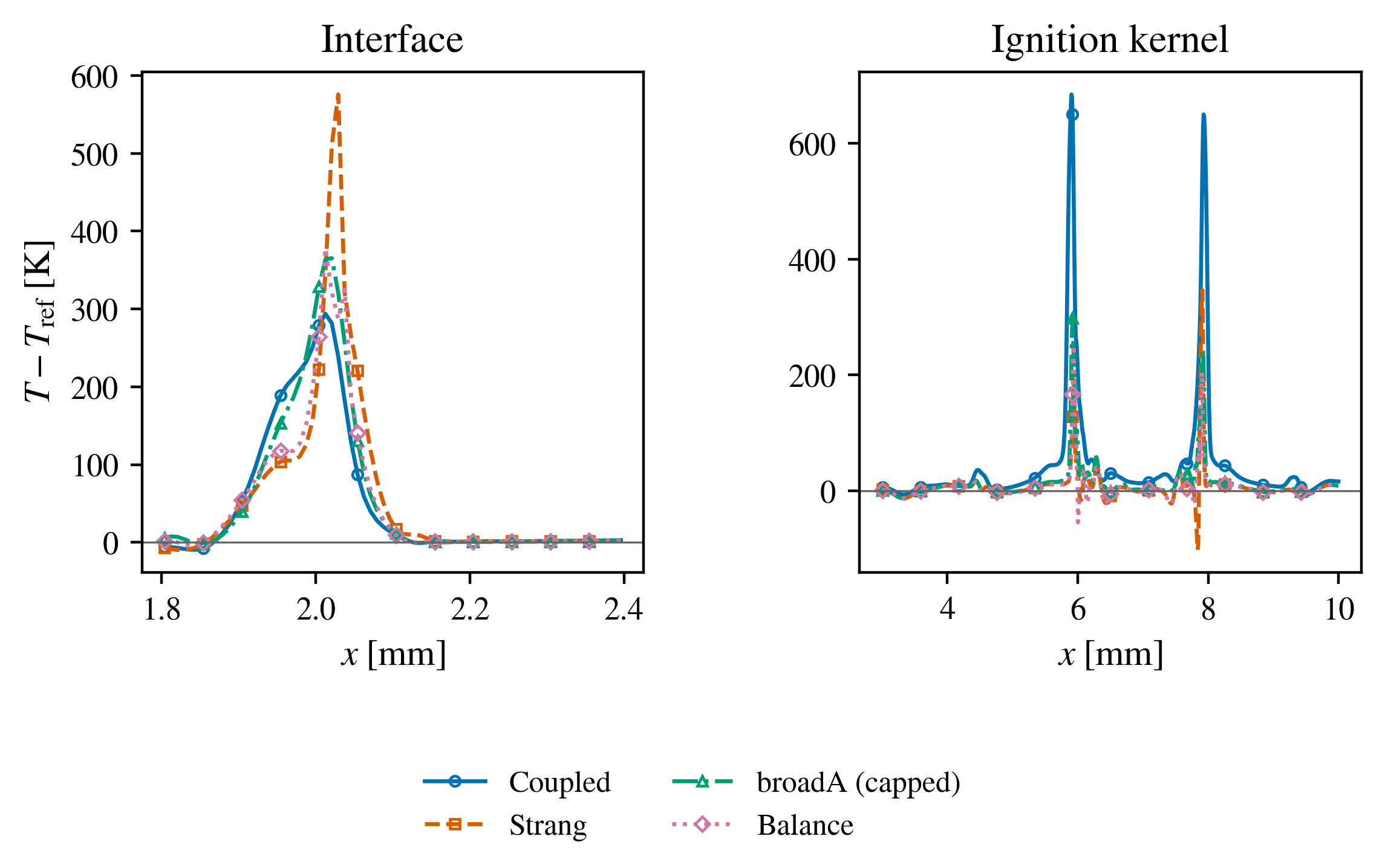
Signed spatial error, not only summary norms. Coupled’s kernel mismatch is broad enough to increase the mean strongly; interface shifts give narrow positive/negative error structures. A better mean does not imply every cell is closer to the reference.
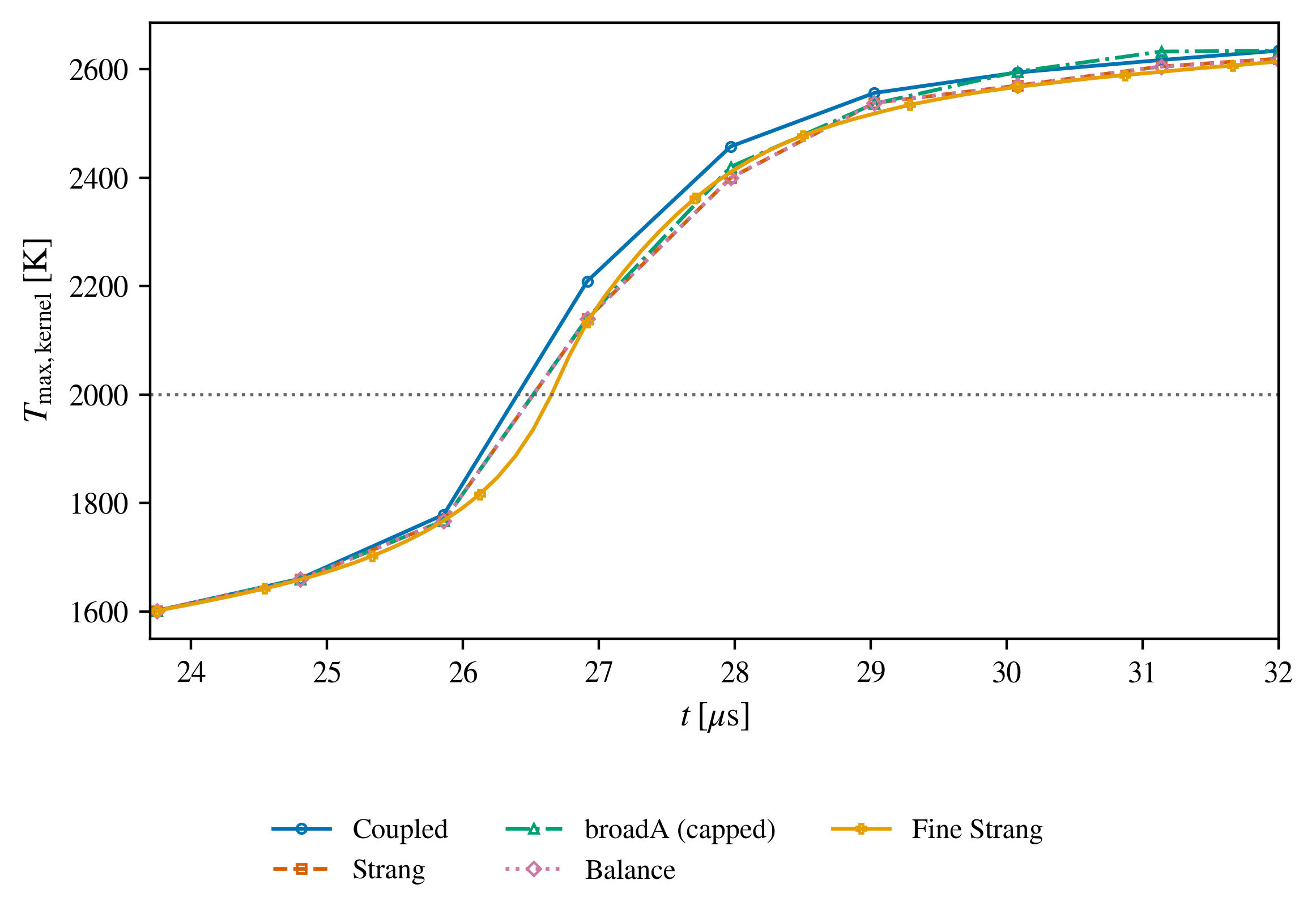
Kernel maximum through the restart window. The dotted 2000 K line is a convenient spatial marker, not the homogeneous peak-heating ignition definition. Crossings are interpolated between saved steps and inherit cadence uncertainty.
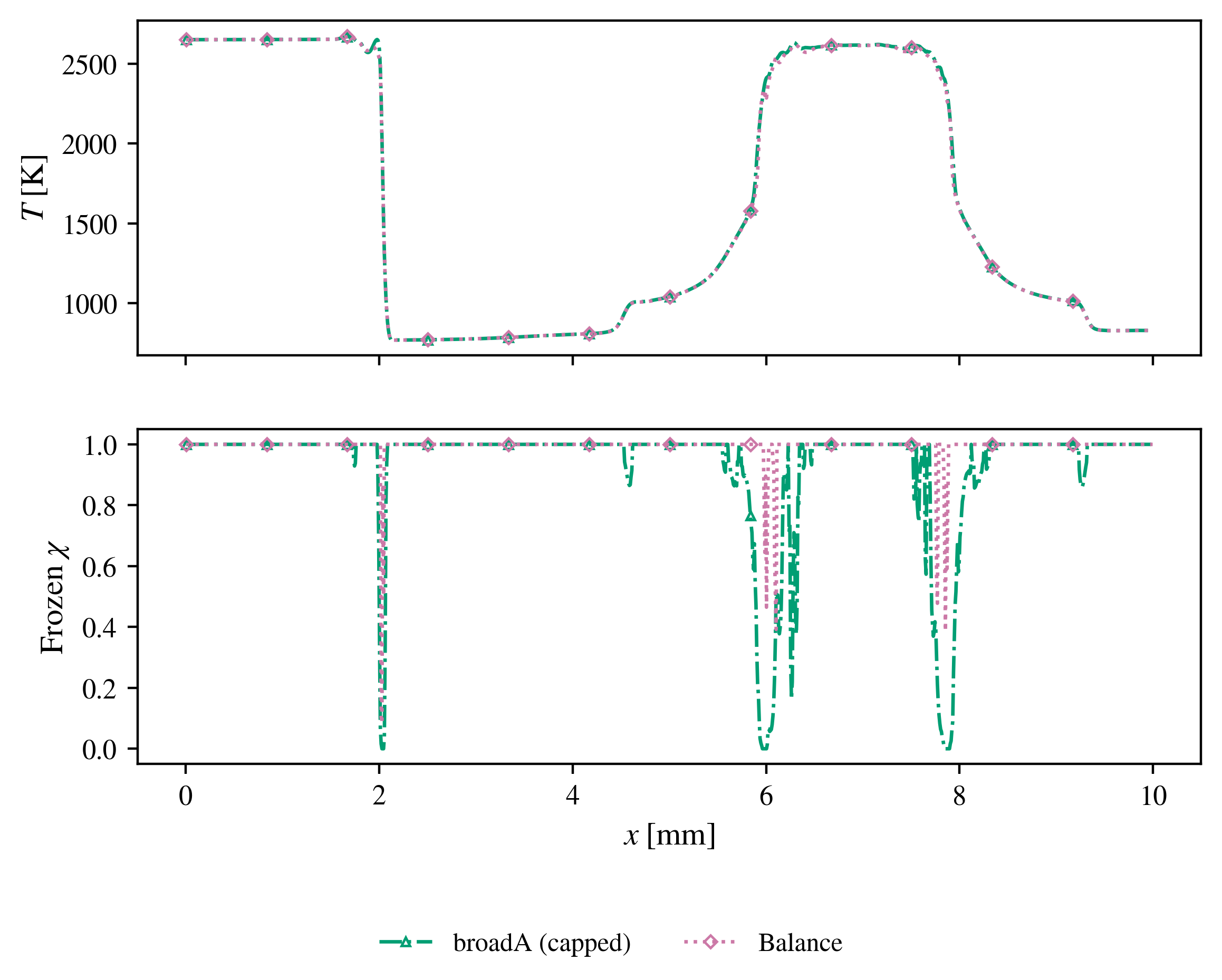
Final temperature and last frozen selector. Balance restricts mixing much more than broadA. The selector was evaluated at the start of the final shortened step; it is not a new a-priori evaluation of the endpoint at the full nominal step.
At \(2\times10^{-4}\), all three original treatments converge: coupled, Strang and broadA have interface means 18.40, 17.21, 23.29 K and kernel means 9.15, 4.12, 3.56 K. BroadA is therefore not uniformly better as the step decreases. Balance has not been run at that smaller step.
Why these results motivate Balance, but do not finish validation
The strongest present result is a regional tradeoff: coupled has much worse kernel accuracy at matched large step, while Strang has a worse interface maximum. Balance reduces both kernel norms relative to coupled and both interface norms relative to Strang, with every stage converged. Its runtime is about 17% above Strang and 45% below coupled in this one comparison.
However, Balance’s mean-error gains over Strang are only 2.58 K at the interface and 1.06 K in the kernel, smaller than the corresponding reference refinement differences. Coupled still wins interface maximum error. The candidate and older controls also use different executable hashes, although the isolated patch adds mode 3 without changing old modes; no repeated-run timing distribution is available. This is a promising matched-step result, not a universal or reference-independent superiority claim.
Reserved \(8\times10^{-4}\) results
All numerical cells below remain placeholders until terminal reduction, restart identity, actual timestep histories and stage convergence are checked. The intended step is 2.110818 μs with physical CFL 1000; four steps would reach the endpoint if unclipped. No half-step smoke result substitutes for this test.
| Treatment | Numerical assessment | Interface mean / max | Kernel mean / max | Convergence / wall |
|---|---|---|---|---|
| Coupled | Failure observed; terminal reduction pending | — | — | — |
| Strang | Pending integration | — | — | — |
| broadA | Pending integration | — | — | — |
| Balance | Pending integration | — | — | — |
Execution-only update, 03:47 UTC 29 September: the monitor observed coupled
exit 134 after about 52.9 minutes, following a Cantera UV-state-recovery error
and ChemicalSource.cpp:757 assertion. The serial launcher advanced to Strang.
No completed coupled endpoint or accuracy number is inferred. This note is not
a continuously refreshed queue dashboard; the three remaining rows retain
placeholders in this curated edition even if their live status later changes.
Reserved figures: matched endpoint profiles, interface/kernel mean and maximum errors, actual timestep history, and convergence/runtime at \(8\times10^{-4}\). No empty axes or fabricated zero-error curves are drawn.
What should be tested next
- Complete the already-authorized larger-step comparison and retain failed or capped rows visibly. Do not optimize the selector against failed outputs.
- Refine the common-window reference once more, preferably with a second converged temporal treatment, before claiming small Balance-vs-Strang wins.
- Replay Balance on the H2/O2 flame/detonation snapshot controls before any posterior extension. It must not trade away broadA’s useful flame band.
- Check threshold robustness around the selected nice values, with fixed masks and metrics. A narrow “winning” coefficient is not sufficient.
- Keep equal-step accuracy primary. Timing supports a possible benefit here, but chemistry kernels, load and inner convergence still confound broad efficiency claims. No extra run is authorized by this reporting list.
Provenance and local reproduction
The study manifest and
frozen curation evidence
record source hashes, all compact inputs, regional metrics, flame coverage and
the 52-row detonation table. Base solver commit:
b7cb11e7d53b24346c63128a1a2db335b4d0ac04. Balance uses the isolated
codex/rri-diffusion-balance worktree with a patch that was uncommitted at build time, SHA-256
ed2e81a38584b33c672a15126b41ac40217f8953df37b7ee8b86000db18dd614 and executable
SHA-256 d02b034370e55c33ca4fe31e1015d5f1b82006418a452c2c713a081dc6362eda.
It must not be described as a clean committed build. The original controls use
executable SHA-256 198979b0ea9b8cb8ab0f5918ad7da04d0a486bc4035da998beec915aad9f0f5e.
The Balance source is now published as DNDSR commit
c8de3c508f87c7b67d05bfff99d6809519a084a8 on
codex/rri-diffusion-balance. The commit hook changed only whitespace relative
to the recorded run patch. The original patch and build hashes remain intact:
publication did not rebuild or replace the running executable.
Run from this repository with NumPy and Matplotlib installed:
| |
The first command regenerates dated-summary PNG/PDF figures and evidence from compact arrays, excluding all \(8\times10^{-4}\) posterior rows by design. It does not rewrite the narrative reports or start a solver. The other scripts reproduce the trajectory, earlier comparisons and frozen selectors. The NTC/flame figures retain their source-study reproduction instructions. No raw VTU/VTKHDF or remote access is needed to regenerate the illustrated profiles.